Made in Bangladesh

Kind liegt unter Nähmaschine "Made in Bangladesh"
Margi Geerlinks: "Pinocchio"

Margi Geerlinks

Sometimes the workers in the sewing factories in Bangladesh compete in sewing like teams of athletes competing in an elite sports event – until they are completely exhausted. Whoever produces the highest number of pieces is the day’s winner. Winners in art are the creatives, in dance studios for example, who participate in a market that has always denied behaving like a market.

Arnd Wesemann
Arnd Wesemann

Do not
boycott
our
products

Every child knows

that three euros is very cheap for a T-shirt. Dirt cheap. A bargain. They even know that others have been exploited in its production. But am I not also being exploited? Who can afford to spend a fortune on a shirt? Why should I, with my measly wage, worry about the measly wages in a faraway country that hardly anyone knows? Bangladesh of all places: Nobody flies there, nobody wants to stay there, nobody returns from there and says it was nice. It is terrible. Three euros for a shirt from a terrible country. Not a cent more. Three euros for a corrupt country that, according to Transparency International, just about ranks 146th out of the 177 nations under scrutiny. It will remain in this place as long as a third of the members of its parliament own one, two or even more textile factories and fight tooth and nail to ensure that their prices remain negotiable, that the unions hold back, and that costs stay as low as possible. That’s understandable when they are selling shirts for an unbeatable three euros each.

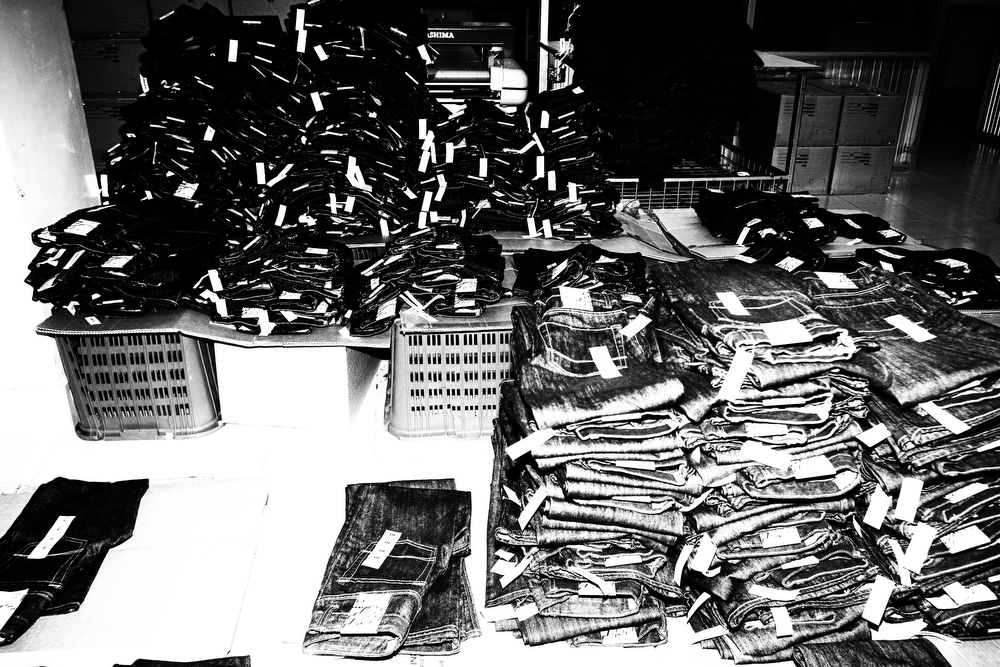
Nafis Ahmed is a photographer in Dhaka, the capital of Bangladesh. His stark series of black and white photographs shows the reality of life for female textile workers. Here: finished jeans in a sweatshop. Sweatshops are small craft enterprises that are at the bottom of the textile industry hierarchy

Nafis Ahmed

It is a proud country

whose lobbyists know that shirts, skirts, blouses, dresses, suits, and everything else that falls under the term “garment industry,” are the main source of income for this small nation of 60 million people, embraced by India, bordered by war-torn Myanmar. They are all lobbyists: the factory owners, the unionists, even the workers. Across the board, they talk about the great importance of these clothes, which seem rather expensive to them. Prices are relative. They are proud because Bangladesh finally managed to free itself from Pakistan in 1971 after a bloody war of independence. Today, they talk about “their” factories in the same way that Germans talk about “their” automobile industry, “their” engineering, and “their exports.” As is the case in Germany, this sentiment is also tinged with fear in Bangladesh. Because if it were no longer “their” industry, “their” achievement, “their” capital, then they would have nothing. Three euros for a shirt is all the more fascinating when you ask what thoughts this price elicits in American and European minds. Without a doubt, Bangladesh must be a haven of corruption, child labor, and collapsing factories. Although we know that assembly lines, streamlining, and 3D printers have long been invented, this knockdown price can only mean one thing: Poverty, corruption, cholera, stupidity, and misery must be rampant in this sweltering alluvial land at the mouth of the Ganges – horrific working conditions. Those who want to avoid contributing to these conditions tend to buy T-shirts for twenty euros. Often these T-shirts come from the same factory.

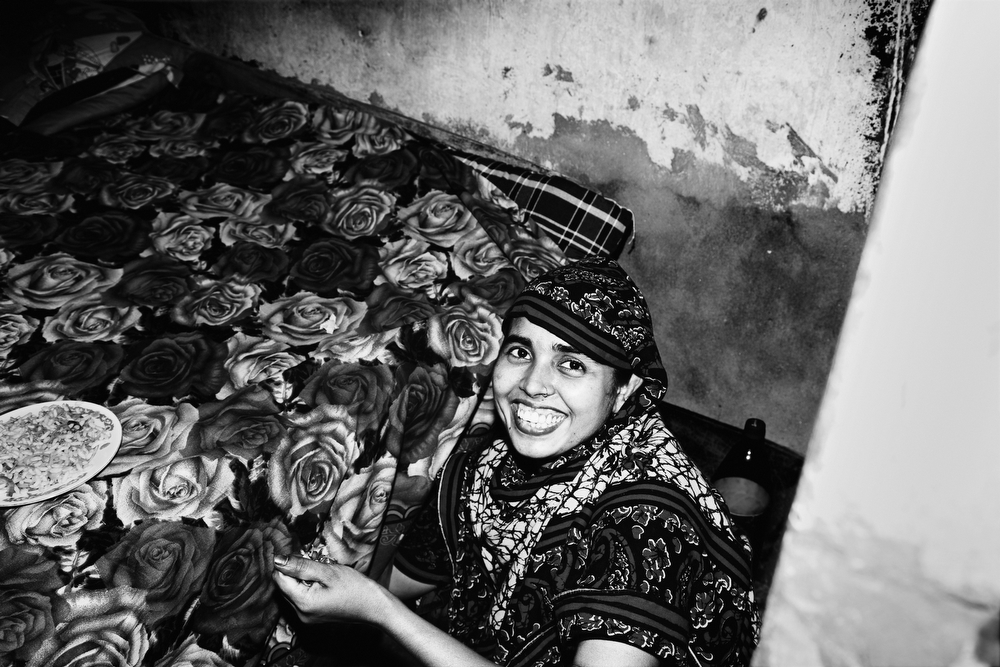
Shahana is beaming. Today was payday

Nafis Ahmed

Leading activists for the rights of seamstresses demonstrate in front of the Jatiya Press Club and Dhaka. In the middle well-known Nazma Akter

Nafis Ahmed

Do not boycott our products,

say the workers. They will gladly add a “please.” Because when a few wealthy Westerners decide to deny their children the pleasure of shopping for heaps of disposable shirts at Primark or Zara, it impacts their income as well. The female workers (who make up about 80 percent of the workforce) seriously fear for their jobs in Bangladesh. They have been told of the reaction the horrific fire at the Tazreen factory in November 2012 and the brutal collapse of the nine-story Rana Plaza factory building in April 2013 triggered among consumers in the West. In the first case, a supervisor had padlocked all the doors because he had previously failed to take sufficient care to protect the cotton fabrics from theft. When the fire broke out, the escape routes were locked shut and the man with the keys could not be found. In the more recent of these two infamous events, there had been a power outage – a common occurrence. When the heavy diesel generators then kicked in, the typical trembling they created caused one of the ceilings in the Rana Plaza made from concrete that had been mixed using too much sand to collapse at 8:30 a.m. on April 24. All the other floors of the building, which had only been approved for use as an office building, disintegrated in seconds, heaping up like china plates. As with every such fatal catastrophe in Bangladesh, the first fear in the collective mind, even in the midst of disaster and in the face of the loss of colleagues, relatives, friends, was the fear that a now impending boycott in the West would see buyers move on and order their clothes elsewhere, that the bribes that had allowed the 5,000 to 8,000 factories to be built so quickly in this country would now be spent in other nations. Amid the powerlessness and grief, there was sheer fear that a level of misery might return from which the people of Bengal have not recovered to this day.

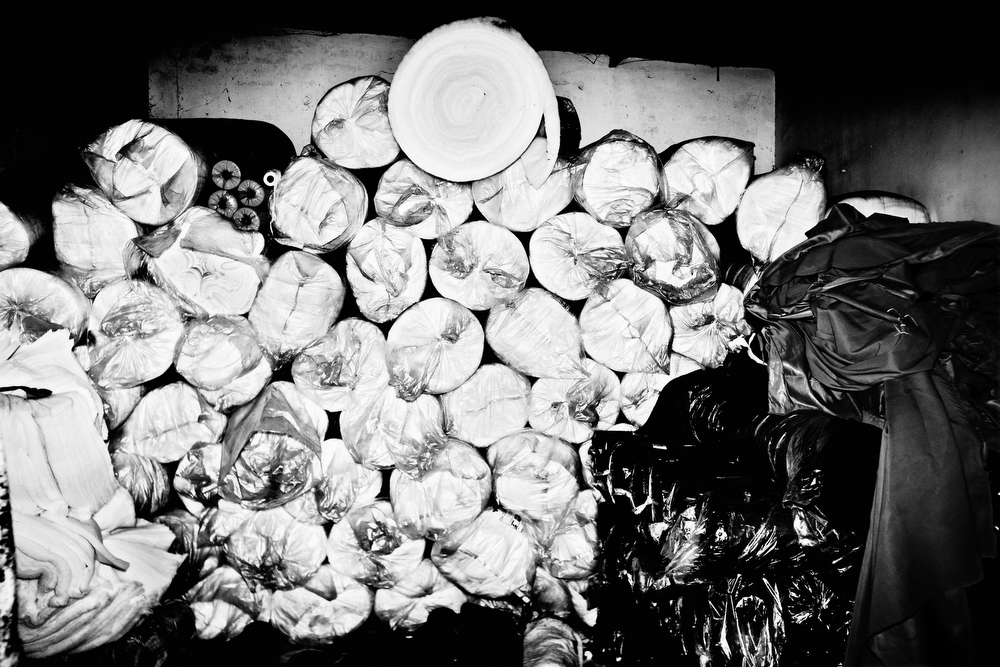
The finished product, rolled and protected before being loaded for export

Nafis Ahmed

This misery

originated in a completely different century. The area that is now Bangladesh, surrounding its capital of Dhaka, was world famous for its skill in the art of weaving. The very light, semi-transparent, flowing muslin, a blouse fabric made of raw silk and cotton produced in the countryside using a technique that was passed down through families, was already in high demand in ancient times. In 1757, the British took over this richest region of what was then India and which was also coveted by the Portuguese and Dutch. They took control of the looms, the products of which were also highly valued in Persia, Egypt, and Turkey. At that time, the money flowed into the tropical country not because it produced the cheapest clothing but rather because it manufactured one of the most expensive woven fabrics in the world. Almost 300 years ago, just like today, a good half of all dress fabrics worldwide were made in Asia – the best of them in the territory of Bangladesh. Silk shawls, shirts, and ties characterized 18th century European fashion, all reliably shipped by the British East India Company, which had been based there since 1660. Wordsmith Daniel Defoe made little attempt to curb his mockery when the colorful muslin and white calico penetrated into every corner of England and transformed the dull peasant island into a place of distinguished modernity for the very first time.

Der Preis war ordentlich

Muslin does not come cheap, and the English did not enjoy any discounts until the Battle of Plassey in 1757, when they took control of a country called Bengal and could then levy taxes. They also used the revenue to purchase the coveted muslin. Purchasing costs dropped rapidly. While prices initially remained relatively stable due to the activities of a good thirty competing dealers, by 1797 there were only three dealers left in a cartel that was able to cut prices by well over half in joint sham competition. And because the “economy” was flourishing, it was possible to successively increase the taxes owed by the Bengali manufactories had to pay to the British. In order to generate enough money to pay the higher taxes, they had to supply more and more fabric, and because they had to produce ever greater quantities to meet the tax burden, the price fell. The state monopoly, which was well protected by the military, squeezed the last bit out of the workers. The luxury fabrics became cheaper and cheaper – for the merchants. Only Europe’s consumers felt none of the effects; they paid the prices set by the monopoly.

Single mother Moni and a Helix Garment Factory inspector at her home in Ashkona, a poor neighborhood of Dhaka in close proximity to Hazrat Shahjalal International Airport

Nafis Ahmed

And the Europeans were delighted

The best-known muslin product of its time was the knee-length ballet skirt that flowed and billowed elegantly around the dancer’s legs: this skirt was also known as the romantic tutu. It was not until the 20th century that it was altered to become a short tutu made of perlon or tulle – and for a terrible reason. At that time, it was not spotlights, but open gas lamps that illuminated the dancer’s swinging dresses on the front stage. Time and again, they caught fire. Indeed, so numerous were the wretched victims of the art of dance that this skirt, painted in such infinite variations by the painter Edgar Degas, had no chance of surviving. (However, only few spectators boycotted the ballet when its dancers died in full view in the same agony now suffered by the workers in Bangladesh.) Instead, the dancing skirt characterized the brilliant career of a ballet that with its soft, flowing fabric effectively pirouetted itself out of a stiff, courtly discipline into ever more fantastical and exotic worlds. It was only in muslin that the ballet had become successful and soon fed into precisely that wanderlust and exoticism that had wafted into Europe from the colonies. Ballet itself became a colonial power. It followed the tracks of the world trade to Japan, China, Turkey, America. Schools and companies sprang up everywhere, many of which still enjoy an international reputation today. There was only one exception: the Indian subcontinent, where muslin originated. Ballet never even made it anywhere near the weaving mills of Dhaka. It never gained a foothold in Bengal or along the Indian coasts. This was not due to any lack of Britishness on the part of the inhabitants, whose rulers enthusiastically drove Rolls-Royces and whose descendants today indulge at least as eagerly in British-bohemian club culture, bingo, and cricket. Rather, ballet appeared to be perceived as an insult. Its dress was too conspicuous a reminder of the ignominy of their own exploitation. (The more common explanation remains equally correct: out of resistance to British culture, India created its own national art around 1920, which featured its own classical dance, Bharata Natyam).

The sewing line at an upscale garment factory in Dhaka

Nafis Ahmed

The nationalization

of muslin production by the English was a nasty trick, though certainly not nearly the cruelest one played in the history of colonialism. Even today when an industry establishes a monopoly with government assistance, it is often considered a great socialist achievement. The fact that workers then had to produce at the loom at a fixed price without any alternative automatically meant that the price dropped. In order to survive, workers can only try to increase their productivity. The more people serve the same buyer, namely the buyer to whom they also pay taxes, the more dependent they become on the buyer’s pricing. The buyer can now purchase more products from them at greater discounts and thus at an even lower price. In Germany, this is still the case today for theaters. They produce more and more and receive less and less support to do so. This heralds an endless downward spiral, the end result of which is exactly the figure that is so excellently reflected today in a three-euro shirt: free tickets.

But is that still the case?

There is no longer a state cartel in Bangladesh; on the contrary. Nothings seems more powerless than this country governed by two “battling begums.” That is what they call the ever-alternating ancient presidents: Khaleda Zia of the Bangladesh Nationalist Party and the currently governing Sheikh Hasina of the Awami League. It is not they who dominate politics, however, but all the clothing manufacturers, from Kik to Tchibo to Aldi, from Esprit to Benneton, from CA to Mango, from Marks Spencer to Mothercare, from El Corte Inglés to Abercrombie Fitch, from Lidl to Rewe. They are in fierce competition with each other and all have local representatives to place orders with their selected factories. Walmart alone, for example, works with 279 garment factories in Bangladesh. Of course, the buyers compete for the cheapest producers in the name of the free market economy. A price war is raging, which the inhabitants of the capital experience as constantly overwork. The army of workers travel in battered buses through a never-ending cacophony of honking vehicles that stutter through the metropolis of Dhaka in a perpetual traffic jam and stop near modest huts that know nothing of refrigerators and air-conditioning, but are surrounded daily by religious observances meant to mitigate the blows dealt by price increases. Galloping inflation, an exquisite expression of progress, allows no escape from this screeching anthill.

Female workers live in cheap tin huts such as these homes in Gazipur in the far north of Dhaka

Nafis Ahmed

Kitchen with two cooking areas used to feed fourteen families in Gazipur

Nafis Ahmed

A traditional family of six, who built the bamboo home in which they have lived for the past 21 years. Such families are usually supported by the wife

Nafis Ahmed

Dhaka

is a Moloch with an estimated population of 10 million. This capital city with its minimal infrastructure, boasts just one lush quarter – a single green island at its center. The rich live in Gulshan, in close proximity to the diplomatic missions of all manner of countries. All of the city’s posh clubs are also located here, and insist on permanent memberships. The rich stick together. Only ambassadors and foreign merchants and their families are also admitted without hesitation. They all know each other well and can immediately and unbureaucratically handle any problem that may arise amongst themselves. There are guards in front of every walled club. Behind the entrance are one or more swimming pools surrounded by tables at which the waitstaff serve cool beers that are otherwise hard to come by in the Muslim country. A proper restaurant is a matter of honor. A billiard room, a library, and a massage parlor are also standard. At the “International,” one of the better of the good clubs, I ask an HM representative for honest answers.

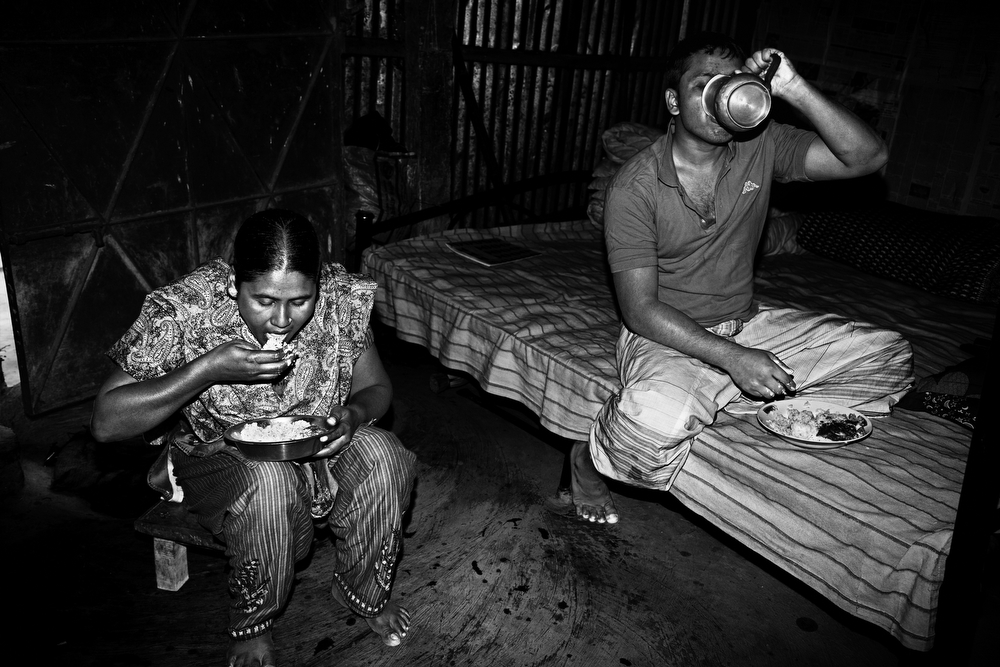
9 p.m. Hena cooks dinner for her co-workers at a factory

Nafis Ahmed

Workers can often only wash in public places like this one

Nafis Ahmed

To be honest,

he is ashamed. ashamed. Truly. He has never been driven by one of the countless, skinny-legged rickshaw drivers, still cannot meet the eyes of the myriad beggars at every intersection, and it grieves him that many workers still have to toil for up to 18 hours a day in small factories where conditions are deplorable. “It is dark, the whirring fans blow dust and lint around. The sewing is often done by hand, yet each piece is identical. Madness. And the T-shirts are white. How they stay so white, I don’t know – given the filthy workshops where they are made.” But, he asserts, these are only the factories for importers, “who buy what is produced in Bangladesh at rock-bottom prices. These importers do not place orders for production here. They just buy what they find for the discount stores that sell the junk of the world to the poor in Europe and America and don’t care about working conditions in the countries of origin.” However, even these retailers still want to appear honest when they recite their laid-back motto: We sell the products of the poor for the poor of the world. H&M and other brand-name companies used to act in exactly the same way – it’s just that they now see things in a somewhat different light. Because they got scared. Even though they now place their orders with a relatively safe, relatively modern factory that is not in danger of collapsing or bursting into flames, its owner still has the option of passing on part of the order to disreputable subcontractors. Thanks to the even cheaper prices of the subcontractor, they can always earn an extra margin: “Tazreen was the kind of subcontracting factory that no European ever got to see. And Rana Plaza was one of those old buildings with all these micro factories under one roof.” The fire in one and the collapse of the other were a wake-up call. “Everyone here understood that their reputation was at risk if the labels of global retailers were found in the rubble.” A total of 1,134 dead in the Rana Plaza collapse, 112 burned in the Tazreen fire: “no brand in the world can afford that. You have to protect your own name, that’s why you make a choice these days. You look for factories that are built safely and wired properly.” Today, he said, every factory has to go through a “social, safety, and environment” inspection process. That’s not politics, of course; that’s company policy. “And that, unlike politics here, has a lot to do with separation of powers.”

The tripartite power of the system

“There is the buyer, whose job it is to secure the cheapest price. This is a purely commercial act. The buyer has nothing to do with the inspector. The inspector’s sole task is to determine for the management which factories are allowed to produce anything at all. And then there is the assessor as an employee of the brand, who monitors compliance with the regulations on site in the approved factories.” These regulations have been devised by a private initiative called the “Bangladesh Accord on Fire and Building Safety.” An assessor supervises safety, working conditions, and manufacturing practices as well as wages on behalf of this private, non-governmental agreement. The contract is thus no longer awarded to the cheapest supplier, but to the factory that can be monitored best.

The monitored party

In the wood-paneled office of a factory that is subject to this kind of monitoring, Hossain Shakhawat sits enthroned behind a desk that has been polished to a mirror-like sheen. The piece of furniture is as large and long as a king-size bed. Hossain Shakhawat calls himself Chairman of the Rishal Group, a family empire in Bangladesh that operates four garment factories and two weaving mills, owns a hotel in the U.S., three local private schools and a solar power plant, and is involved in numerous real estate deals and other exotic ventures. He is a made man, mellifluously singing of the nation’s progress from his eleven-story garment factory in Dhaka. How this unique country is pulling the cart out of the mud using its own strength! How consistently it invests in education! And how it has become such a serious player in international business! Until the talk turns to the foreign assessors in his company. Suddenly his well-nurtured face tightens. “It’s a game of cat and mouse,” he laments. “Of course, it’s not the buyers’ fault that we pay such low wages. The buyers are just doing their job, driving my prices down. That’s normal.” Rather, he says, it’s the assessors sent by Western customers who come to him once or twice a month and tell him what still needs to be improved in the name of safety. “We are completely at the mercy of these people,” he complains. “Other factories that are not being inspected don’t have these additional costs and can easily undercut me. Here, on the other hand, what happens is that one day one of the assessors wants me to buy smaller tables so that there is a wider escape route through the aisles; then, the next day, that same assessor says that these tables are too small and not good enough for the workers. One guy wants better fire extinguishers, so I buy them. Then the other one asks me to upgrade the electrical system.” And: “These assessors also get to look at my books on behalf of my customers. One customer wants overtime to be paid well, so the assessor finds a case where someone worked eleven hours and now he’s looking to see if I have paid overtime in this case. Fine. Then the very same man comes back again on behalf of a different Western company. This company doesn’t want the workers ever to work more than ten hours. The inspector knows, of course, that this is not the case in my company. What do I do now? Do you have any idea of the terrible power these guys have?”

Sure,

money can be very persuasive here, too. Still, who pays for this upgrading of the factories in Bangladesh? Who pays for the much-lauded progress? Certainly not HM or any other brand, according to Hossain Shakhawat. No matter what price they would be willing to pay: it is the factory owner and his bank alone who invest and increase the value of the company. This is the only way he can earn more – “in the long run.” At the same time, however, it is customary for the “good” customers to push down the price of each shirt produced with each new order – as if there were some kind of loyalty bonus for international textile retailers. In numbers: The cost of improvements to the factories has risen by around twelve percent in recent years, while the prices for finished garment prices have fallen by a whole three percent. This cycle of imposed investment and reduced revenues either costs jobs or leads to wage dumping.

“That’s the way it is all over the world,”

exclaims Azim Shahidiullah, rolling his big eyes. He is the vice president of the local textile industry association and spokesman for the top lobbying institution in Bangladesh. Of course, factory owners continue to make excellent money, he says, and grins when asked about his colleague’s complaint: “He is doing business, isn’t he? He’s not here for charity.” And yet factory owners face more and more risks. For example, if his deliveries are late, which means he will need to pay penalties. He calls it the “Tchibo Effect” because it was the Bremen company that first established this rule: If the delivery is one day late, the factory receives ten percent less than the amount originally agreed. Two days: twenty percent less. If he negotiates badly, the factory owner still remains on the hook even if the bottleneck occurs elsewhere, for example if the ship does not leave on time or cannot pass through the Suez Canal on time. But all of this, he says, is testament to how reliable Bangladesh has become – better than its competitors. Myanmar, by way of comparison, is far too expensive. And this is not just because of the current unrest. Azim Shahidiullah explains in business Chinese how heavily Myanmar still relies on the “CMPT” (“cut, measure, package, and thread”) approach. He mentions how great the distrust of the factories is in such countries and how the customer has to deliver everything to them himself, from the cut to the measure to the package to the thread, so that the factory can then use the components to produce a shirt. Then he emphasizes how well “FOB” (“free on board”) is working in Bangladesh (where factories themselves acquire all the materials required to make a shirt on the market). This saves the retailer money and a great deal of hassle in terms of logistics. It also considerably cheapens the price of a product. You can only get rich if you make something that is particularly cheap and are able to sell it at a high price. That is the law. And it does not just apply in Bangladesh but also in Europe and the U.S.

An older worker. She is 34 years old and brings home the equivalent of 14 euros per day. When she started, her pay was 1 euro

Nafis Ahmed

From the perspective of Bangladesh,

such improvements in production correspond exactly to the type of progress that we call “development.” The fact that two factories collapsed and thus attracted a great deal of media attention soon saw some very well-loaded planes heading for Hazrat Shajalal. Plenty of anxious meetings took place in Dhaka, organized by non-governmental organizations – among them the textile industry itself. Nazma Akter, a resolute woman who has a habit of running her hand across her nose, sniffling, also received much accolade at these meetings. She is the best-known labor leader in Bangladesh and founder of the Awaj Foundation in Dhaka. She has been a voice (Bengali: Awaj) for the rights of women workers since 2003. Akter, who began working in the sewing industry at the age of eleven and recently also appeared on various European TV shows as a brave female veteran factory worker, emphasizes that, in addition to the top issues from the perspective of the West that are so urgently discussed in Bangladesh – sustainability, environmental protection, energy efficiency, resource conservation, legal security and building safety – there is a hugely pressing human and moral issue that almost never makes it onto the agenda: “Female workers deserve respect,” she says, “and in speaking of the actual lack of respect, I don’t just mean ‘typically female’ issues like harassment in the workplace or even being paid lower wages than the men. Rather, I’m asking the fundamental question of why no one is ashamed to saddle female workers with all the unpaid overtime and child-rearing without giving them even the slightest chance of improving their unhealthy living conditions.” This in a Muslim country that has always ranked women somewhat lower than men. She drily concludes: “We are not respected, because we are cheap labor.”

Child labor is allegedly never permitted. Shagorika, the seamstress in the middle, claims to be 18 years old, as do her co-workers

Nadif Ahmed

So let us first turn workers

into truly skilled workers who are educated and trained appropriately. In Bangladesh, when people talk about education, they mean, above all, an introduction to the art of mechanical engineering, to the organization of mass production, or to environmentally compatible waste disposal rather than social work, education, nursing – professions that deal with human dignity. In keeping with the hierarchy of professions, the latter are also poorly paid elsewhere. Unlike those in humanitarian, caring professions, however, female factory workers have the advantage of being able to hope for a gradual improvement in their conditions “in the long run.” Humanitarian professions hardly exist in Bangladesh, anyway, and, just like in the West, are strategically being rebranded as volunteer positions. People should help people unconditionally wherever they can, without expecting something in return. With this appeal to the moral side, voluntary service now promptly lands in the upper echelons of starry-eyed idealism, and thus escapes the economy. Unpaid assistance is cleverly refined into a commendation fit for one’s biography and thereby drops out of the scheme of exploitation.

Such statements are met with

hearty, but above all appeasing applause. There is still so much to do in Bangladesh. After all, it is only just at the beginning of the road to becoming an emerging country. What else are Western system analysts supposed to say when, as infrastructure planners, they carry their own attempts at a solution from country to country? How does the exploitation of women concern the lobbyists of international corporations who search in every nook and cranny, always on the lookout for an opportunity to close the many huge gaps in the market in the name of health, the environment or simply as lawyers? Unless they end up featuring in a high-profile court case, the rights of women, i.e., human rights, simply do not figure in this equation. Instead, the dictum of “education” is making the rounds. “Education,” says Daniel Seidl, Executive Director of the German-Bangladesh Chamber of Commerce, “has set in motion a process from socks to shirts to shorts to shoes to shrimp to chips to solar,” fueling the nation’s rise just as it did previously for China: “From there, they are now passing the orders here, the orders for the expensive ski suits or racing suits that only the Chinese were able to produce in the past. Now it’s Bangladesh’s turn,” he says. Education increases productivity. And when productivity increases, then this in turn increases education. The human rights problems will soon solve themselves.

Part 2

CHEAPEN
THE
ART

Art is also

discovering volunteerism. Famed performance artist Marina Abramovic recently advertised four positions assisting with the launch of a digital magazine entitled “Immaterial” – four unpaid, literally immaterial jobs. Zero euros for four volunteers at her Marina Abramovic Institute in New York – even the artistic community rebelled that at a time when Western society is in the process of demanding a minimum wage for all professions. For artists, too? After all, in Abramovic’s case, a minimum wage of zero euros goes hand in hand with a rare opportunity to be within sight of a hip celebrity. Even though she collected $660,000 for her Internet magazine on a crowd-funding platform, this money was not earmarked to properly feed her future minions. The curt defense for her decision was that her fellow artist Jeff Koons “employs” far more volunteers than she does. The more slaves, the more popular the artist.

Is Marina Abramovic exploiting her workers?

This question seems to echo the question of whether seamstresses in Bangladesh are being exploited. There, women pride themselves on becoming independent so they can escape their rural conditions and lead a self-determined life – with all the risks and side effects that may entail. Abramovic also led her self-determined life at great risk for a long time. She allowed complete strangers that visited her gallery to experiment with her body. She made herself an object for society for hours without moving. There was nothing sinister to this act – only her own free will. Because nobody likes a life that is determined by others. Nobody likes alienated work. Marina Abramovic always rested within herself. Those who see her perform wish to be able to delegate all states of being controlled, all stupor, all exploitation to machines, so they can revert to their own free will; finally live like an artist. Creatively. For, according to Friedrich Schiller, an artist is someone who appears to be free.

Zero euros

for voluntary artist slaves – the most fascinating thing about this is the image that zero euros conjures up in people’s minds. Apparently, zero euros in itself encompasses the freedom to be able to forego anything in return. All the volunteers who cheapen art as well as social and care services could pave the way to a basic universal income – that’s the thinking in some parts of society. Take volunteer firefighters and disaster relief workers, for example, who, like every volunteer or good friend, lend a hand when someone needs help. If these are the good guys, why should Marina Abramovic be the bad guy?

Labor is becoming drastically cheaper

Apparently, there are more applicants than jobs, even in the zero-wage sector. The state of North Rhine-Westphalia recently confirmed that 238 adolescents were completing a voluntary year of social service in 189 of its cultural institutions. Applications are also piling up for Marina Abramovic. Now, she does not have to rationalize, optimize, or control a position that is free. She could rent it out like a suite in a five-star hotel. That is what art relies on. It is also the basis of every competition for architects where prizes are non-monetary and which consumes a great deal of energy and manpower and only rarely leads to success; it is the basis of auditions for dancers who travel from all over the world at their own expense only to be eliminated in the preliminary round; it is the basis of pages-long applications for funding for a documentary film or a choreography, which take weeks to formulate, not to mention the long process of securing co-producing theaters and calculating the budget. People accept such unpaid work in the hope that one day this effort will pay off down the line. It is not called exploitation but “gaining experience”: perpetual pre-qualification. But it does not even constitute an actual qualification. The monetary equivalent of this unpaid preliminary work as part of the process of possibly gaining entry into the cultural sphere exceeds the revenues of all box offices. Only children of rich families can afford to volunteer with Abramovic. Of course, they would never claim that they were being exploited.

The milking

of students, interns, guest students, assistants did not begin in the private sphere – it began long before that on public territory, in public institutions. Internships in broadcasting stations and theaters existed before the industrial and art sectors discovered the free worker. The volunteers have always been there because they study voluntarily, constantly scaling new cliffs consisting of exam regulations and tuition fees, and yet are nothing more than victims of an industry that is based on the promise that its aspirants will eventually find a job which allows them to make truly independent art. Universities have long nurtured the myth that they are able to think in a manner that is free from industrial constraints. Their research is only free, so they claim, because they release their students into the world as emancipated people – even if they have to pay back bank loans or are expected to provide something in return for their industry grants. In the same way, Dhaka, that enormously pressurized metropolitan container, feeds the myth that the seamstresses here are emancipating themselves from their origins and cruel values such as forced marriage at fourteen and unpaid farm labor. It is often said that their emancipation is helping to make Bangladesh more prosperous. For the zero-euros caste of young intellectuals in this country, this same emancipation serves to finally give them the leisure to view certain things in a different light thanks to their education. Instead, they could also ask why seamstresses in this country are so deliberately portrayed as victims worthy of protection and not as emancipated workers. The reason: It is only when you want to protect these female workers that their work can take on a negotiable value. In order to increase the value of labor, even the earliest unions portrayed the worker as a noble hero with a hammer in his hand, who gets own with things, who serves his country and its prosperity, who gets up early and seemingly knows no pain. And yet this hero is always the first victim of any recession, factory closure, economization. The eternal victim also requires eternal protection.

This image

of being a victim of capitalism is also being adopted by young researchers, young journalists, and young artists. The evil “free market,” as they contemptuously refer to the “creative industry” within their circles because it pays them absolutely nothing, lies in wait for them. In return, it grants them – still in zero-euros mode – only those experiences that academics have always dreamed of, namely to be able to be a manager, an artist, an important cog in the cultural industry. What they call their professions does not matter. In truth, even the self-appointed manager is only a salesman in the eyes of the customer, the artist only a designer, and the self-proclaimed producer sometimes lives on much less than a worker. So, is not the creative person also in need of protection? No. He is just a volunteer. In this zero-wage sector, no one needs a reason to fire a volunteer. He will leave voluntarily.

You can also fire yourself.

An academic lecturer at the University of Leipzig received a fee of 480 euros gross for preparing and holding thirteen seminars. That comes out to 37 euros per hour. This hourly rate, which is quite reasonable for an academic, would be realistic if she did not prepare at all for her session. What does she do instead? She grits her teeth; she even makes it complicated – completely voluntarily. The challenging topic of her seminar session is: “What is the cultural value of art today?” Let us put that question to Nazma Akter. The Bangladeshi labor leader does not think twice. “Art is an occupation for daughters and sons from better homes,” she turns up her nose. Perhaps she might change her viewpoint if she better understood the benefits of art. She asks: “Could theater help seamstresses see through their own living conditions? Do they learn to move better through dance? I mean, because they make the same hand movements in the same posture all day.” If art were “a useful product,” which must not be “too expensive” because female workers don’t earn that much money, then she would even find art quite okay.

The public sector

uses exactly the same argument. In principle, it thinks exactly like the labor leader. Using dance as a proven means of improving children’s health and discipline, for example, is common sense within our community of values. Of course, instead of trying drugs, adolescents should go through puberty in a more physically creative way. Dance also improves the ability to learn and helps the brain become more coordinated. Dancers get into less mischief. But when it comes to promoting dance as an art form in its own right, we come up against requirements that are viewed solely from the perspective of the market and utility. Whenever there is a tourist, educational, or at least politically correct value at play, the Western “community of values” tends to support culture with an entrepreneurial heart: In the case of artistic risks, it beats faster, and where there are possible side effects it runs riot. This is also what happened in the small Hessian town of Bad Hersfeld when the public sector, led by its mayor Thomas Fehling, cut funding for the oldest festival theater in Germany by 400,000 euros – a process that is also familiar in the textile industry. Politicians, like textile merchants, do not have to keep paying more and more for the same thing. On the contrary. A good customer always deserves a discount. A manufacturer must reduce the price if he wants to keep the retailer happy. In the same way, theater manufacturer Holk Freytag, the artistic director of the Bad Hersfeld Festival, who was under the watchful eye of the municipality and the state, was asked to incorporate the cutbacks demanded by his customers into his new program and budget and to submit them to the municipal authorities, i.e., the inspectors of his “factory,” for approval. To make matters worse, Freytag had already generated 300,000 euros less revenue in the previous season and had thus fallen short of the expectations placed on him. This artistic director, whose customer had learned so well from Bangladesh, took offence and resigned. According to the local newspaper: “The mayor has not yet found a new artistic director, but has already held several talks and has received a great many applications. (The mayor) is thus confident that he will be able to announce a successor in the near future.”

How many shirts are produced per row per hour? The count is right in front of every single seamstress at all times

Nafis Ahmed

In Bangladesh, too,

it is easy to lose your job in one of the countless textile factories. But here, finding a new one is no problem. Demand for helpers never ceases; all they need is to be able to put the two layers of a pant pocket on top of each other exactly enough for someone else to sew them together. If the helper learns to operate a sewing machine in just a few days or weeks, they will need a successor. This kind of qualification in Bangladesh works much faster and cheaper than it does here, and all at a pathetic wage that no helper can live on. This means that the helper wants to move up to operate a sewing machine, may soon be able to attach the finished pant pockets next to the crotch, will then delve into the pitfalls of the zipper or assist his colleague the sewing robot, which can attach the buttons in a matter of seconds. The helper becomes a worker, then a foreman, then a manager of a floor, and through experience eventually an expert in economization. He learns early on that he only has to remove the protective cover next to the sewing needle to be half a second faster sewing ten shirt sleeves. There is only one criterion that is important in this line of work: How many shirts are being produced per row per hour? The count is right in front of every single seamstress at all times. Hour by hour, it is noted on a chalkboard. Each seamstress always knows how fast her row is compared to the other rows; all of them strive to achieve the greatest possible speed from the rough cut to the collar to the finished, ironed shirt. Up to twenty such production rows compete with one another daily. It is no coincidence that the results on the board are reminiscent of a sporting event. Poorly-sewn shirts or defective machines are reported on smaller boards. All of it looks like an entry in the class register, with bad students being removed on the basis of this information.

One interesting thing

about this organization is the obtuseness on which it is based. It is also interesting how little superstructure is needed within this hierarchy. Most of those responsible for monitoring processes or cutting costs here stand together with the workers on the production line. Everyone has someone above them. Everyone has someone below them. The order is “objective.” It is the result of a coefficient of measurable performance and verifiable result. Optimization and inspection are integral parts of the production process itself. The shift ends when a certain result has been achieved. The West takes credit for apparently keeping this hierarchy much flatter. Here, a team optimizes and monitors the processes. This team is not part of the competition between several hierarchically structured sewing lines. The opponent is the team itself – because everyone on a team has a very similar level of expertise, they all compete with each other. No one dares to leave the office before 7 p.m. anymore. Everyone simulates the greatest possible importance vis-a-vis the others. Whereas parental leave and home office appear to mitigate this competition, flat hierarchies are nevertheless more labor-intensive, especially in competition with each other, in the struggle for the best arguments, against perpetual misgivings and the well-known weaknesses of colleagues. Terms such as “employee motivation” hide a no-holds-barred attitude that produces such contemporary “diseases” as bullying and burn-out. Teams create pressure not from the outside, but from within. They do not have to keep up with results or machines; they simulate their own efficiency, outdoing themselves in long, beautifully-packaged meetings with ever deeper cuts into their own structures. Western corporations, universities, and even theaters tend to subject every monitoring process to yet another monitoring process in order to uncover mismanagement and justify the formation of infinite new departments, according to Parkinson’s Law, to constantly seek new ways of communicating between departments that have long been alienated from each other so that management consultants, lawyers, accountants or – as in the theater – technicians, dramaturges, and operations offices can still understand each other to some degree. Work in Bangladesh, on the other hand, is archaic. People slave away by the piece, without co-determination rights or vacation entitlements. They are, quite simply, anti-creative.

The uncreative

are defined by their role as victims. This role can only be compensated for with money. The creative, the idea generator, the optimizer, the artist, on the other hand, makes himself a victim – of his own free will. Whether his work succeeds or fails is his own entrepreneurial risk, as it were. That is why the artist seems so likeable, “even in his failure,” as Kathrin Tiedemann, director of the Forum Freies Theater in Düsseldorf states. In the two small venues she had at her disposal for a long time, the song of control was a familiar air. Control takes effect as soon as the city transfers 50,000 euros less. What does she do in such a case? She does what a factory owner does: “save on staff. Or everyone would have had to give up part of their salary so that they could all keep their jobs. But fortunately, it was possible to reverse the decision to make the cuts. In fact, politicians have repeatedly suggested that I simply schedule fewer performances. They say nobody needs this much theater. But it’s not that easy. There is an industrial mechanism, even in independent theater. An artist submits various applications to various agencies. Sometimes, this even raises enough money for an actual professional production. Theaters like the Forum Freies Theater live on these co-productions; we design our programs based on them. Our own artistic budget is extremely tight, but if each artist raises additional funds, his production and our theater can work together like the parts of a well-oiled machine. This almost automatically results in an annual output of around 300 performances. Even if I don’t aim for it, it’s the exact result that the funding policy helps produce in the first place.”

And what happens,

if the authorities were to transfer another 100,000 euros less? “Then the Forum Freies Theater would have to close one of its two venues. But how do you explain that with a turnover of 1.4 million euros a year? There is always still a bit of breathing room before you say it won’t work anymore. There’s always an artist who says they’ll do it for less. Conversely, cultural administrations like to avoid discussing an appropriate budget. At the same time, the funds allocated to the arts are controlled solely by politicians, which, in times of doubt, can make you panic. It shows you how much you depend on their decisions. If you are threatened with a cut, you feel like an independent entrepreneur with many employees whose bills have not been paid and who is now running out of money. But the power of the political sector also lies in the fact that when there are deficits, as was recently the case with Vienna’s Burgtheater, it can simply step in and fork out millions as if it were a bank. That increases the power of politics over art immensely.”

This power was also felt

by Florian Malzacher. The former director of the “Impulse” independent theater festival in Cologne, Düsseldorf, and Mühlheim an der Ruhr was threatened with a cut of 200,000 euros in the 25th year of its existence. The public art foundation of North Rhine-Westphalia, which is organized under private law, had pulled out at short notice. At such a moment, you want to vent your anger instead of politely expressing gratitude for the support you have received so far, as is customary. If Malzacher is still resentful today, when funds seem to have been pledged again, it is because of the “lordly attitudes of those who administer public funds as if it were their own money they were allocating and not that of the people. As though public money went to a private individual, not to someone managing an institution. Who manages it? A theater manager, for example. He is not elected, and there is often not even a real call for applications, let alone a jury of experts. Instead, if you’re lucky, you receive a phone call and are supposed to be grateful that you were even considered.” Accepting the position of theater manager is not followed by budget negotiations, as you could readily assume; no, the budget is already fixed and nothing can be done without raising third-party funds. It is part of the basic principle of all festivals and theaters never to have enough money to produce what is expected by the public. This shortfall is part of the conditions – however, it is not called a shortfall but rather an allowance, for which you must give thanks. A clever theater manager does not fuss like Holk Freytag, but keeps quiet until a path opens up to a better-funded cultural institution elsewhere. As a theater manager or festival director, you think that you are now at least free to design your own program. But that is not the case either. You are dependent on the money that the artists bring in. And the artists, in turn, live on the approval of applications by a committee. These applications are also cut, even though they must explicitly allow for a minimum wage for all participants. As a result, fewer artists are asked to participate, especially since you cannot cut the costs for the technicians, who are protected by collective agreements.”

Is this complaining at a “first world problems” level?

“If that means the intellectual level, then yes. Managing a cultural institution or being an artist means being exposed to indirect, structural censorship long before you have even started working. Artists write concepts that they expect to be compatible with the ideas of the theater managers or curators, who in turn formulate their programs in anticipation of the city’s expectations. Everyone wants to explore the scope as much as possible, but there is often a premature submissiveness: “always having a preconceived notion of what you have to do to be ‘successful’,” says Malzacher.

So that means

the independent scene is not independent? Kathrin Tiedemann says: “The independent scene is very efficient, more efficient than a theater with a permanent ensemble. That pleases the financing bodies. The independent scene is cheaper. But the politician also thinks: In order to get as many citizens as possible to attend a theater, the theater must present a certain level of quality.” It is once again like the situation of the textile merchant: He wants the best goods at the lowest possible price. He knows that any price can be driven down. To do that, you just have to downsize the permanent ensembles and replenish them with cheaper artists from the independent scene. “I think the price is also falling so much right now because there are more and more artists, because children today have to constantly participate in musical education programs from kindergarten to preschool and all the way through school and perceive themselves as ‘artists’ from an early age. You can’t blame the next generation of artists for that. It is an ‘Army of Artists,’ as the Dutch theater maker Jan Ritsema calls it, while the taxpaying public on the other side of the equation is becoming increasingly suspicious and blaming theaters for burning our tax money. This doesn’t exactly strengthen theater’s position, especially when it doesn’t want to be a product, but a celebration in the moment, a live event. Nevertheless, a certain value is attached to it and this value is measured in terms of audience numbers or admission fees, making it more like a product than an event. This misses the point of the theater because it forces it to act under the pretense that profitability is its very purpose.”

The zero-euro artist

can watch the price spiral in independent creative professions reverse. At the same time, cultural institutions, including universities, are fighting all the more fiercely to avoid any appearance of economic dependence – at the price of greater dependence on political goodwill. The following paradoxical principle applies in art: It is art only if it succeeds despite all avoidance of economic intentions. Even if this success is reminiscent of an industrial scheme: If the artist produces the same thing over and over again in similar variations, if a choreographer prolongs his first success to the point of certain recognition so that the buyer may rely on the artist’s name to know exactly what he is buying from the outset. The artist must never really change this formula, his “artistic” method – to the point of self-denial. This applies to revered artists such as the Belgian Anne Teresa de Keersmaeker just as much as it does to entertainment commodities at the level of a Christmas revue. At this point, however, a distinction must be made. You would need to clarify why a dance event committed to modernity and charged with the ideologies of macrobiotics is much more artistic than the entertainment considered suitable for bus tourists, which takes the same effort to produce, yet is referred to so contemptuously as commerce. In fact, an entire industry of hope is busy saving art from commercialism for very little money, despite the fact that it is known that the earnings of a dancer at the Berlin revue theater Friedrichstadt-Palast, for example, are on average three times higher than the income of a dancer who goes on tour on the independent scene.

The avant-garde

is already one step ahead. It is not only saving on jobs, but also on expensive art spaces. Florian Malzacher finds that “in this sphere, one development is particularly interesting: the residency. An artist is a guest in a small studio and is asked to show a free ‘work in progress’ in return, as it were. This ‘lab,’ which is actually intended to help artists find their own way through trial and experimentation, has become so fashionable as an event format that it has long since become a successful genre in its own right. In this way, the lab became exactly the cheap product that it actually wanted to defend itself against so that it could be a free space in which public attention and market value were not the point.”

The independent scene

therefore views itself as a product of market liberalization – its vanguard even. Its members became cheap laborers when they began to rebel against the official structures of the municipal theaters, only to become an extended part of that so-called ordoliberalism, subjects of the sovereign, state power. Half a century ago, the independent scene fought against the municipal theater, the operetta, the farce, the well-cured dramatic heritage. At the time, it had no idea that its alternative would today be dominated by the economy, of all things. Of course, artists crave success. But at their academies, they have learned that this success is never determined by themselves, but always by others. Just as a market price is hounded up and down by supply and demand, just as the price of labor is chased through rounds of collective bargaining, the price of art is set by crowds of spectators and box office receipts as well as by what might be called its industry of distinction: It includes critics who are supposed to value things; it includes academic dignitaries who declare artists to be the object of their scholarship; it includes publicly-funded curators who invite one artist to their theater but not the other; it includes juries who must pit one artist against another in deciding who will receive a meager grant. These all determine the artist’s respective market price; and they do so without profiting from it themselves. That is precisely what makes them unassailable. They may have an intellectual interest in the artist, but it is hardly ever reflected in their own wallets. They are patrons because they never participate in the success of the market. So, in truth, no one helps anyone. No critic will allow herself to be deprived of the freedom to change her mind. The same goes for academics, theater managers, and jury members. There is no business that is based on mutual trust. Arbitrariness, zeitgeist, and fads prevail.

Art is brought to market

and breaks – not because of the market but because of the distinction. An oil painter cannot be compared with a graphic artist. A lyricist has nothing in common with a novelist. A trumpeter is not a clarinetist. Where individual disciplines defend their own spaces, so that ballet does not have to compare itself with opera, for example, they all become incomparable. This means that they not only keep their distance from the others, but also that they cannot show solidarity, unless they are working on the same piece. This is intentional. That is why the artist is weak.

In principle, then,

we must once again question the image of the artist. Kathrin Tiedemann of the Forum Freies Theater in Düsseldorf says: “Maybe there have long been no artists anymore. Maybe there are only workers left.” Perhaps the artist was the antithesis of the worker; at least this was the idea behind Paul Lafargue’s “The Right to be Lazy.” Once again, this 19th century polemic has become highly topical. Why do we even consider the artist as a worker who has to live for his art around the clock and constantly show results? “Why does the Croatian conceptual artist Mladen Stilinovic claim in his polemic ‘The Praise of Laziness’ that art cannot exist (anymore) in capitalist society?” asks Kathrin Tiedemann: “Why can’t the artist say: ‘I would prefer not to …,’ like Herman Melville’s Bartleby? Why don’t they oppose our concept of work?” Artists cannot do this, as you can tell by the language alone: The artist creates a “work,” he shows his latest “work.” He “produces” a piece. He would have to consequently stand up against the economization of his art. And that is actually what he does, says Florian Malzacher from the “Impulse” festival, who sees the artist as part of the political movements. “The artist acts as an opponent of official politics, like Ahmed Ögüt with his Silent University, like Jonas Staal with the New World Summit or the Center for Political Beauty in Berlin, and many others who associate art with activism, dance with political movement, acting with public speaking. Just as, conversely, political activists have long since resorted to artistic, or at least creative, means. They declare a theater occupation a performative act, as in the Teatro Valle in Rome, or use theatrical means during demonstrations.” To oppose the economy: “Officially they make political art, but in fact they vegetate in a shadow economy because art doesn’t keep them fed.”

The movement

as an expression of protest is not fed by the invisible, public hand. Not directly, anyway. Indirectly, however, the protest of a movement makes an impression. This attention also motivates sneaker manufacturers and T-shirt industries to emulate the artist rebels. They offer rebellious T-shirt prints for sale for the politically active citizenry, giving it the appearance of resistance, pinning an anti-capitalist token on it, and praising its boycott of inferior goods on T-shirts that are “Made in Bangladesh.” Public institutions follow the same path – including the theater. It curiously eyes the engaged citizen audience and wants to “meet” it where it would much rather be than in the theater. In the summer, citizens can attend free open-air spectacles in exchange for voluntary donations. The audience in the urban space is invited to participate and entertained with flash mobs, even if these are more reminiscent of liturgical services. As in Bielefeld, the audience may even be allowed to dance they piece it has just seen following the performance. As a result, theater appears to be involved in consumption and at the same time critical of it through its participatory nature and thus somewhat political. If this theater takes its audience on city walks to refugee homes, prisons or shareholders’ meetings, then it needs a capable army of unpaid volunteers more than ever to organize all of this and to take the audience by the hand in an educational manner. So, the theater tells itself how close to the people it is without really noticing that it mothers its audience like a nurse for the elderly or a kindergarten teacher, that it teaches it like an adult education teacher or a seminar leader, that it entertains it like a juggler or a comedian, that it draws its attention to topics that would otherwise be explored during a Waldorf school excursion. But the theater just wants to say that artists are committed citizens, too. Maybe it is even saying that every committed citizen is an artist. However, behind closed doors, the overburdened organizer admits how much she needs such events for her “marketing” so that they all continue to go to the theater.

The theater contorts itself

before the economy and looks to Great Britain, to the motherland of the common good and the Commonwealth. There, the “Government of India Act” of 1833 so severely curtailed the powers of the East India Company as an importer of muslin from Bengal that the cartel went bankrupt. For genuine muslin competed with the new domestic machine production, which manufactured cheaper imitations and other woven fabrics. The steam-powered weaving mills in England could make cloth eight times faster than the Asians. That year, when competition collapsed and with it the earning opportunities in Bangladesh, is now synonymous with the term “Manchester capitalism.” Concerning this epitome of predatory capitalism, the extent to which the state itself called the shots by allocating and withdrawing monopolies is often overlooked – even today. In the era of Margret Thatcher, the UK was no less thorough in its crackdown on the arts, again in keeping with the concept of a “common wealth.” Translated into law, this means that the theater has to involve the citizens, that it must be useful to them, and that it has to take into account the socially disadvantaged, schoolchildren, and the disabled. The theater was instructed to form a massive institution geared towards inclusion, with citizens’ choirs, citizens’ orchestras, and, if necessary, with a playbill that would be determined democratically by the people. This drollery has long since spilled over to mainland Europe and is being celebrated – not as an austerity craze, as one might assume, but as a triumph of social justice and a dream of a community freed from market conditions. May the “community” now make the decisions regarding its theater. Only those who do not participate are excluded from this community. No support is given to those who do not volunteer. People flirt with the added benefit of the artist as educator, event manager, and childcare worker. He is expected to prove himself a good member of the community and may hope for local recognition in return. A dedicated artist is always a good artist. For the others, there are stage shows like West End musicals or tourist cultural events, rock festivals, or television stations – where the wings of their “Oppositional Defiant Disorder,” as it is called today, will most certainly be clipped.

Prescribed by politics,

a theater’s right to exist is now only guaranteed if it is social or socially engaged. Internally, conditions akin to those in a free trade zone may continue to prevail. The hierarchical structure of theaters remains untouched, especially by economic premises such as utilization of space and income. As early as 2013, the following letter to the editor from a chief physician at the Clinic for Orthopedics and Trauma Surgery in Bad Mergentheim appeared in the “Theater heute” journal. Christoph Eingartner is also the medical director of the Gesundheitsholding Tauberfranken with its approximately 2,000 employees and thus responsible for a medium-sized limited liability company. He knows how a public hospital works from an economic standpoint: still differently from a theater dominated by politics, which pretends to show an interest in social needs: “The theater as a business, as a company and its corporate culture,” he writes, “seems to me to be essentially marked by the authoritarian leadership of a theater manager who is granted temporary infallibility for the duration of his contract. Of course, it perceives itself as politically left, or at least socially critical, wants to address the issues of the time, wants to make politically relevant theater, or so we read in every seasonal program. The proverbial worker’s fist is raised, but the underlying political stance is of no relevance for the management of the company.

In true CEO style, productivity is increased – more performances and productions with, at best, the same number of ensemble members: If it was possible for an actor to do ten plays in parallel last season, then, surely, they can make it twelve in the next season. As the theater manager, you are happy to be celebrated (or, if in doubt, happy to celebrate yourself) for having had a record number of performances in the past season and for never having been able to reach so many viewers while pledging ‘cost control’ and further increasing productivity. It’s only capitalist exploitation when others do it.

The gap is widening. On one side, there is the precarity of actors who live from contract extension to contract extension (unless they ‘work independently,’ anyway – a nice expression for the peculiar mixture of unemployment benefits, odd jobs outside of their profession, and occasional work contracts). And on the other, there are the jet-set directors, for whom every theater rolls out the red carpet and whose lavish fee demands are gladly accommodated. One can accept all this – the theater as a reflection of society – but then one must say so and not hypocritically stylize oneself as a critic of capitalism.

Engineering, make-up, administration – they work hard and are usually poorly paid, but the rules of a regular company apply: employment contracts, protection against dismissal, working time laws, and all the other ancillary and general conditions that are quite normal for companies. None of these apply to actors. Contracts are concluded in such a way that the next theater manager is free to dispose of the existing ensemble with as little residue as possible. Before permanency can become an issue – after 15 years – a contract is quickly terminated or at least interrupted – for ‘artistic reasons,’ of course. Ensembles are getting younger and younger in order to save money by paying beginner’s wages.
If you really need an ‘old woman’ who is over 40, you can hire her as a guest; the independent actor market is huge, the conditions can be dictated almost arbitrarily (payment per performance, unpaid rehearsals if possible). The principles of Western culture and politeness can be put aside when it comes to dealing with actors. Ignoring requests for meetings, governing like a lord, the casting slip arrives by mail and without comment. The threat of non-renewal, unless the actress over 35, for whom one suddenly ‘can’t think of any more artistic projects’ after years of collaboration, is willing to return to the minimum fee. The shameless threatening and denigration of actors when they insist on their already meager rights. The insolence of accusing an actress who has become pregnant of acting like a ‘charity case.’ The culture of tattling on people, the encouragement of denunciation in the fine tradition of the Stasi era that were thought to be a thing of the past. Compliance with agreed rehearsal times? Work-life balance? Not that important – because who can support a family on an actor’s salary, anyway? To simultaneously criticize capitalism and run one’s own operation in such a relaxed, early-capitalist manner as has long been impossible and uncustomary in other companies smacks strongly of the high art of doublethink. The company for which I am responsible would have gone bankrupt a long time ago if we treated our top performers the way theaters treat theirs.”

Part 3

FAIR PRAY

Does anyone

boycott a theater that allows itself such unfair working conditions, right down to the last dancer? No. It would never occur to anyone to avoid those theaters that employ an ever-increasing number of unpaid and poorly paid people. After all, the theater is financed with public funds. Does anyone boycott stores that sell shirts, pants, and dresses with the label “Made in Bangladesh”? Here is a chance to effectively criticize consumerism. We think: That poor worker in Bangladesh, who has to slave away for so little money, with no pension or social benefits, without being able to organize in a union – we had better buy her shirt. But we can’t buy her shirt, simply because it is not her shirt. So we want to punish the retail chain that sells the shirt, which costs ten cents in Dhaka, at a 300 percent markup.

There was a heated

debate about how to finally put a stop to these capitalists, how to force them to respect fair trade, to pay compulsory levies into an offertory box intended for the seamstresses. And anyway, it’s about time the industry paid the reparations due after the collapse of Rana Plaza and Tazreen fire. If you hear that more families in Bangladesh are suing for compensation than there were victims, and that the bureaucratic mills are therefore only slowly gaining speed, always driven by the wish to pull the country out of the headlines as quickly as possible, then you will at least think that there is certainly more cover-up than clean-up – it’s just a dirty business. Bangladesh must be hell. Hell should be boycotted.

The theater

is bright. It is a place of enlightenment. There is a reason it emerged as a public institution at the same time we learned about capitalism. Today, however, even a silly assertion is enough to make this bright place that is theater go to hell. For example: All things considered, theaters are high-priced venues with sometimes dubious programs. Their expenses, after all, can be monitored by external management consultants. If inspectors come to the theater, it is immediately said that the theater has fallen victim to the invisible hand of the economy. Can the state – as an invisible public authority – put up with its institution being monitored and rationalized by management consultants? Yes, says the state: This is necessary in order to sweep out the accumulated dust, sweep the damp corners clean, and banish threatening mold from its institutions. It has them scrubbed and mopped and always catches the smallest subsidies first. If, by chance, the theater is due a larger sum at some point, this money is usually earmarked for a construction project, for something durable, for the preservation of a historical monument. In the meantime, there is even talk of protecting the entire city and state theater system as a monument.

As scrutinized

as the theater is, no one would think of boycotting it – not even when you encounter artists in its corridors who slave away for little money, who aspire to a pension of 447 euros a month after thirty years as a dancer, who have never been able to express their work in terms of an hourly wage, who are immediately shoved away as unable to work if they have an accident, and who have never been able to organize themselves effectively. After all, theaters aren’t factories. An artist is certainly all kinds of things, but there’s one thing he is not: a worker. You can buy an artist’s artistry, if not his shirt. He expresses his happiness by acting for us when people buy it from him. In return, he pretends every evening that the theater is not really a factory, but a dream, which succeeds quite wonderfully in deceiving us about its origins in factory production – despite or perhaps because of the stage-like appearance, the great voice, the acrobatic performance, the independent play. And even if all this were not art, theater still belongs to our culture. At least, it belongs to the citizens.

The state also

questions what the theater is for. It even asks whether theater only became one of its institutions because it had assigned the theater a task other than profitability. Doesn’t the theater serve to ensure that the audience that sees a performance at the same time always also gets an impression of what it would be like not to howl with the wolves for once? At least that was the perception following the Second World War. At that time, when the state theaters were still traveling the German countryside, democratization and denazification were their primary objectives: Heinrich von Kleist was used to discuss law, Georg Büchner to contemplate an appreciation for leisure, Bertolt Brecht to examine the social and the asocial, and Samuel Beckett to search for the zero point of the postwar era. These were authors who took a critical approach to culture. What united their art was the statement: He who howls with the wolves does not howl with art; he then just howls with culture. The biggest howler, recalls Barbara Gstaltmayr, who worked at the Tübingen State Theater at the time, was “Harald Juhnke. He and all the other entertainers weren’t allowed into the theater. So they built civic centers for them, which they filled to the last seat. The theater alone was still the place for art; the civic centers belonged to a culture for all.”

Culture

was the opposite of art. Art was what theater, art, music, and literary critics defended until no one listened to them anymore. Culture was what proved popular, based on ratings. The theater was like a tailored suit; culture wore casual off-the-rack clothes. Art struggled for meaning from the moment when politics no longer imposed meaning on it, leaving art no longer able to oppose it. Everything that the political sector’s district offices lumped together with education and sports – including family, children, and youth – was called culture. Dance, for example, appeared to be of about equal value to physical education and sports. Culture is interested in musical education and a creative community. It is concerned with social cohesion, not with critiquing this cohesion. For culture, art is a legacy from the past, a source of inspiration on which it may draw, emulating what has been successful or repeating it in fashion-led retrospectives. Without art that is critical of it, culture is the selfie of our society.

An artist is free.

He is not bound by instructions. In a capitalist society, he is an independent entrepreneur who sells his wares. If he is successful, he deserves it. But an artist in the theater? He is condemned to be a hermaphrodite under the thumb of cultural policy. Artists would like us to believe that they are self-determined geniuses, professionals and soloists in their purest forms. But in the orchestra pit of the municipal theater, the same musician is asked to produce a very specific sound at a specific time as part of a certain, contractually stipulated service with a specific intonation as prescribed by the conductor. In order to succeed in this, he has undergone a long, arduous training. Should he not succeed, he is out. The musician is part of an orchestra that is organized hierarchically into six salary levels. As such, he is even part of a force. In view of the 2,122 positions lost in German orchestras since 1992, this force is even allowed to go on strike. But how does this right help him? “In the past 15 years, there has been enormous pressure on German theaters to save money,” says Klaus Zehelein, former chairman of the German Stage Association: “About 6,000 jobs have been cut across all branches of German theater, and the number of positions has dropped from 45,000 to about 39,000, while the number of independent contracts has almost tripled from about 8,000 to about 22,000.” The effect of these figures is that orchestra musicians are completely subordinating themselves to an even greater extent while at the same time committing themselves one hundred percent mentally and physically (paraphrased based on Milan Turkovic’s book: “What musicians do during the day”). The musician as an artist in public service on the salary of an elementary school teacher is just as bound by instructions as a seamstress on the assembly line. But at least he gets to enjoy the envy of his dance and drama colleagues when he visits the cafeteria. His union status is somewhat better. He is not an entrepreneur; he is a valuable worker from an educational perspective.

He is a cultural worker.

He fiddles on command. He sits in the orchestra pit at 146 decibels and intones Richard Strauss’ “Elektra.” Meanwhile, his colleagues in Dhaka have to put up with 147 decibels at any given intersection; 90 decibels is considered the upper limit in factories. In fact, working on the sewing lines on the eighth floor of a factory in Bangladesh is a lot more pleasant than being outside. Fans quietly move the air that penetrates through billowing curtains into the small halls. Machines hum, clatter, knock, rattle. The HM representative closes his eyes pleasurably and wanders through the factory aisles. He turns around abruptly, opens his eyes wide, stares in one direction and scolds a foreman. “For me, the music of a factory is very important,” he explains. “It lets me know immediately that things are productive, that everything is working or not working. So I don’t need to see what is going on along the lines. I hear it. There you have a constant noise level, there is a ‘hum hum’ sound, like waves, as you walk through the factory. Here the waves are like this. Here they are different. And here you don’t hear anything because the line is slow. You can walk through blindly and say which line is producing the most. You don’t have to look. You can compare it to an orchestra. A factory is music.”

Art

is something very useful in this bourgeois understanding. The artful orchestration of a symphony is admired not least because it is based in principle on the same form of organization that keeps a factory running. Music may even be an orchestral machine, like the one composer Heiner Goebbels staged in 2007 in “Stifter’s things,” which featured autonomous piano robots. In 2014, Italian choreographer Romeo Castellucci also managed without a single dancer or musician in his “Sacre du printemps” choreography for “40 machines with music by Igor Stravinsky” – instead, the machines ground up tons of bone dust. The only real workers were needed to dispose of the white sacrificial meal. Musicians are rationalized away to the extent our culture wants them to be when it dreams itself as a machine without the alienated worker or musician. Culture dreams of the t-shirt without the many overtired and underpaid seamstresses. Culture likes to dream of a sewing robot that can produce the same thing over and over again in any place in the world without any additional transportation costs. At the same time, culture dreams of a sovereign artisan who, without alienation, is able to hand-sew a sinfully expensive coat, deeply rooted in tradition that will last a lifetime and withstand all fads. It is this artisan who usually works in the theater today: the virtuoso dancer, the poised actress, the confident singer, recreating Redbeard, Hamlet, Don Carlos. The old is repeated. To this end, artists are employed to celebrate the reconstruction of Berlin Palace every evening, as it were: at the lowest possible price for the ostentatious work, at the least possible expense that culture allows us today to transfer its old classics into the current culture of rationalization.

Black Swan

is the name of a 2010 film that masterfully showed how a dancer raised her Odile/Odette from “Swan Lake” up from the coffers of romantic art, and in the process applied all the measures of rationalization to herself. Courageously, she walked the cultural walk to self-perfection. In the film, Natalie Portman portrayed a ballet dancer who seemed to have the strictest discipline, an iron will, and complete control over her life – and perished in paranoia. At first glance, Darren Aronofskys psychological thriller had formulated an impressive critique of the ballet industry – and German ballet directors from Hamburg to Berlin to Munich were quick to agree that if there really were so much anorexia and such merciless competition in their own firmly established ballet hierarchies, their companies would be “a case for the public prosecutor’s office.” These directors were even sure that they need not fear the judiciary. But why would they be so sure, when they can employ full-time assistants for up to six months without pay, or when their dancers, in obvious competition with each other, are never allowed to show weakness and therefore never show any solidarity either? Because. Because these things are legal. For Darren Aronofsky, however, “the constricted ballet world with its rigid set of rules and its stifling tradition, was a wonderfully atmospheric adventure playground” to show what a cultural imperative really is: People must never notice the conditions of production under which a cultural commodity is really created. For him, art would be to show exactly these conditions: the ambition, the asceticism, the working conditions of high-performance athletes or ballerinas in a culture that in the United States goes by the name of “Arts and Hobbies” – and which, because of its intended voluntariness, eludes any labor laws. That is why ballet administrators were so shocked when the film hit the theaters. They claimed to have been thoroughly misunderstood. The daily drudgery had to be reinterpreted. No, what the dancers are doing is not exploitation but self-liberation. Just like the seamstresses in Bangladesh.

The emancipation of women

in Bangladesh from their rural subservience can only happen in a city full of factories, where their own money, their own flaunted tastes, their free choice of partners and friends have made women independent for a mere two generations now – if only they did not have to keep working in a soldierly cadre with equally industrious comrades-in-arms. Every day the same 12-hour processes at the sewing machine; every day the same pressure to earn a living again. Unpaid overtime, unpaid or underpaid wages, working even with a fever of 103. Everyone is horrified if we talk about such conditions.

It is considered an affront

if we asks about the conditions in the culture industry. But we can also pose the question differently, as Darren Aronofsky did. We don’t have to point to today; we can equally view the culture industry and its repertoire as a stronghold of the tried and true. If we ask about the conditions under which works of art were created back then, we will hear the resounding triumph of today over yesterday – jubilation about the cultural progress that has been made since then. Today, people dance healthier, on a better dance floor, are better nourished, their parents are much more likely to support their profession – financially. And if a ballet caused a scandal back then? Then it was precisely this scandal that ensured that its causes have since been culturally and triumphantly overcome. The scandal of barefoot dancing, the scandal that a ballet such as “Sacre du printemps” caused in 1913, is showcased today like a photograph of the birth of modernity. The dancer’s self-liberation is celebrated behind glass: Loie Fuller, Isadora Duncan, and Mary Wigman. These have been elevated into the repertoire of contemporary cultural history as the founding myth of emancipation. What is forgotten, however, is the extent to which these women once threw their bodies into the fight against the impositions of the very culture that oppressed them. That it was they who used art, as art, for cultural change.

Even today,

many artists are shocked to see the culture in which they live. An artist is a worker insofar as he works on his culture. We want to or have to stand up to it instead of serving it – for a measly wage. Nobody wants to be conscientiously faithful to its scores. Culture, too, has nothing against putting up with a different interpretation of a piece of music, a drama, a novel. It likes it when old myths appear in more original garb, if only the formula, the harmony, and the chords continue to be right. Culture even pays homage to the old avant-gardes that defied these constraints, in purpose-built museums and commissioned reconstructions, new editions, and reinterpretations. But what if the old rage that once created a work of art returns in the young body of a performer? When her exertion is no longer reduced to the stubborn repetition of gestures? When the violence of the body breaks through?

Then you have to control the violence.

The body must be stopped. People felt it with an almost medieval shudder when, on January 17, 2013, a glass of acid was hurled in the face of Sergei Filin, the ballet director of Moscow’s Bolshoi Theater – the head of the theater where, ten years earlier, ballerina Anatsasia Volochkova had been fired because she was – allegedly – too fat, and who – now a slim politician – described her former theater as a “brothel” during the trial of Filin’s assailant: Every dancer knows that being invited to dinners with patrons and oligarchs often involves a physical commitment that is not limited to the artistic. Compared to this, Darren Aronofsky’s “Black Swan” remained on the level of an entertaining children’s fairy tale. While the background of the Moscow attack remains well veiled to this day, the target of the intrigue becomes all the more visible. It is the body itself, be it too fat, too scared, or too blind for the very institution that, as a cultural organization, is intended to celebrate nothing but the physical ideal. Like a discordant note in the opera, a lie in the theater, ugliness damages the ballet. This was already the case when a young Cologne mayor named Konrad Adenauer banned Béla Bartók’s ballet “The Miraculous Mandarin” for “aesthetic reasons” in 1926. People had something against the merry murder on the dance stage, the Grand Guignol, which seemed to amplify the war experience of that time into perversion. And today? Today, the official dance stage is just as culturally regulated. One looks at its “material,” the ideal bodies that have culturally transformed from soldierly discipline to athleticism, and, without ever abandoning either ideal, mutate into bodies that are bursting with health, that are stress-free, injury-resistant, and well-nourished. Just what our culture loves: bodies that are almost fully optimized.

Occupational and dance physicians

appraise cultural workers with concern. They ask permanently employed dancers questions about “lifestyle habits, everyday problems, and work-related illnesses.” One such study by the Berlin Charité does not even require an initial suspicion. The pressure to perform that weighs on dancers as well as on pieceworkers in garment factories is already well known. The bar to be hired by a professional company or garment factory is being raised to ever-greater heights anyway. In Bangladesh, better monitoring is supposed to ensure greater safety and, above all, greater efficiency in the factories: “Controlling, Safety, Regulation” are the three pillars that are usually translated as “Corporate Social Responsibility” – a polite euphemism for what is actually the standardization of working conditions in order to be able to further optimize and control them. While the cameras above every sewing line in Bangladesh are reminiscent of the factory owner’s funny monitors in Charlie Chaplin’s film “Modern Times,” they are not even used for surveillance, but to allow visiting customers to see how hard everyone is working on the upper floors on a monitor in the office while they enjoy some freshly poured tea. The West is much more advanced in its monitoring of the body. Not only does the “robotic colleague” measure the break times and performance levels of the “human colleague,” not only is the control and monitoring of public spaces fully automated using telematics, but this monitoring is now also performed through occupational health checks, the precursors of which originated in sports medicine and which has now also made its way into dance medicine.

Medicine

creates a very specific climate of control because it critiques the body. Its critique, packaged as concern for the body, further amplifies criticism of our bodies by the fashion industry, in the mines of which the seamstresses of Bangladesh toil. This critique is also potentiated by a pharmaceutical health industry, in the shop windows of which the athletic bodies of dancers represent the near-perfect epitome of health. They lead the way not only through physical exercise but also as role models in nutrition – they are welcome guests in sleep labs and prime examples of a balance between training and performativity, role models for the perfect balance between constant training and ever-increasing performance. That is is why dance appears so often in advertising: as a metaphor for precision (luxury watches), efficiency (luxury cars), and effortlessness (dishwashing sponges) – without an advertiser ever having to take one look at the stage on which the art of dance is practiced. Advertising only needs the image of successful work on oneself, on one’s own body. This body is represented by the dancer. In return, advertisers gratefully dispense with the rebellious, culturally critical allusions that dominate stages from dance theater to contemporary dance. Feature films also portray variants of hip-hop, for example – athletic rivalry, the competition that created for itself a physique that is just as desirable as that carved out by ballet during the 19th century. Emma Lew Thomas, once a dancer with Mary Wigman and professor emerita of dance at UCLA in California, observed this development first-hand. As recently as 1950, says the 81-year-old, “there was an Italian, a German, a British dancer’s body. Today, it is almost impossible to tell where a dancer is from. The Italian dances in the USA, the American in Moscow, the Frenchman in Germany. This has only become possible because the bodies became more and more alike and standardized at some point. Dance is a cultural form of globalization. Just like classical music.” Precisely because they originate from a more or less manageable repository of scores, its interpretations offer an excellent basis for comparison in a global mock competition. In magnificent buildings, such as the Elbphilharmonie in Hamburg or the opera house in Qatar, production conditions and fee structures that smaller communities have long been unwilling to afford are once again allowed to prevail. A global league of engineers, architects, traders, and bankers are creating their own culture together with their international competitors. They build arenas for themselves that feature a culturally recognized repertoire according to the sporting standards of “best of” – but never any art that criticizes them.

“Made in Bangladesh”, the dance professionals from Helena Waldmann’s production in front of the ready-to-ship products with the same seal of quality

Georgia Foulkes-Taylor

Munmun Ahmed (left) is an authority on Dhaka’s dance scene. She enjoys the fact that women workers in the textile factories can experience the art of dance firsthand

Georgia Foulkes-Taylor

For them, even ballet

is a part of their cultural industry, which hardly differs from other industries. Here, too, any form of collective bargaining partnership is frowned upon. Although seamstresses in Bangladesh hope for the support of the International Labor Organization and were once even allowed to demand an investigation of their working conditions by a trade union, they have come to realize that, as independent workers, they have as little right to such representation as independent artists. In Bangladesh, however, it has at least been agreed that an inspector will only be approved if he has ten years or more experience in the industry (this greatly reduces the selection in a young society); furthermore, the employer reserves the right to decide when and to what extent inspections may be carried out at all. The situation is no different in the international culture industry, which plucks the violin, lifts the leg, sings the song in front of its investors. There are hardly any unions here. Artists who cannot satisfactorily collect outstanding payments negotiated on paper are forced to hire agencies that act in an international legal vacuum when inspecting actual working conditions or collecting outstanding fees. The cloak of silence is spread over defaults as it is over the origin of the fees. A singer who is invited to perform by war profiteers, casino owners, or predatory oligarchies had better keep her mouth shut if asked any critical questions so as not to damage herself.

What does culture do?

It is outraged. At least if, as a community of values, it can agree on the principle of fairness in case of doubt. “Art but fair” is the name of an initiative that has been allowing affected persons to report their “saddest and most outrageous artist fees and audition experiences” on Facebook since February 2013. Initiated by musical producer Johannes Maria Schatz, the forum highlights practices such as the unpaid rehearsals for opera singers scheduled by former Salzburg Festival director Alexander Pereira. The press has been happy to pounce on this new artists’ wailing wall. Birgit Walter, for example, asked the following remarkable question in the “Frankfurter Rundschau” newspaper: “Does anyone complain that 1,000 to 1,500 euros are budgeted for a monkey per day of shooting but only 350 euros for a trained actor? No. The people who want to earn their money on stages and in front of cameras don’t complain.”

Culture must protect artists.

It calls for more transparency (and by that it means more control), it calls for better compensation (and knows the tax authorities agree). It speaks of a better corporate culture in theaters. It is true that terms such as “exploitation” and “compensation for victims” are rarely used in connection with the theater. But “child labor,” which, for good reason, is regulated as strictly in the theater as it is in Bangladesh, and “low wages” exist on both sides. However, in Bangladesh (or China or Africa) they can improve what they want. The image remains; it is consolidated by our self-assured sense of moral superiority.

When the British

withdrew from the area around Bangladesh in 1813, Dhaka was soon little more than a village with only 30,000 inhabitants. Dhaka is still terrified of returning to this today. A hundred years later, the same thing happened in New York: A devastating fire broke out in the Triangle Shirtwaist Company textile factory. According to the official figures, 146 workers died – 34 more than in the Tazreen factory in Bangladesh. This accident in 1911 gave the U.S. labor unions a spontaneous boost. Another hundred years later in Bangladesh, the threat of a similar strengthening in workers’ solidarity was immediately nipped in the bud. The unions there are as weak as the few artists’ initiatives in Germany – from today’s “Coalition of the Independent Scene” back to the “Union of Intellectual and Cultural Creators” founded in 1946. The latter continued to form new coalitions with printers, publicists, and music educators until it became the United Services Union in 2001, whereupon all pretense of fighting for artists’ rights promptly ceased. The artist as a service provider: This was the final mockery of a culture that appropriates the artist as its critic to the point of complete disempowerment. This is the only reason why many artists, deep in their hearts, remain neoliberal loners – and do not fit into our culture.

Be fair,

is the mantra of our culture. It pities the worker as an exploited victim. So we are supposed to engage in “fair trade,” we are supposed to compensate, we are supposed to care more about a country that we only know from hearsay. But why this missionary zeal? What is it hiding? Is there perhaps a greater similarity between Europe and Bangladesh than we would like to acknowledge? How incomparable are the working conditions really? Is it truly impossible to compare the strictly organized work culture in Dhaka with the average behavior of all other employers, be they mail order companies, logistics firms, banks, state-owned enterprises, and thus also theaters? Aren’t they all united by a penchant for permanent economization? Every company constantly strives for even better optimization. It is the same in Bangladesh and at Amazon, and it is no different in theaters. It is the motto of our culture. It wants to optimize itself further and further. The less it is able to deal with criticism at any given moment, the more often it doubts whether it really needs artists for this process of optimization.

If you prefer to read on paper, you will find it here: