Brightly colored

Eun-me Ahn

Sukmu Yun und Jiyang Kim, Grafikdesign: Kyungkyu Cho, Courtesy: Eun-Me Ahn Company

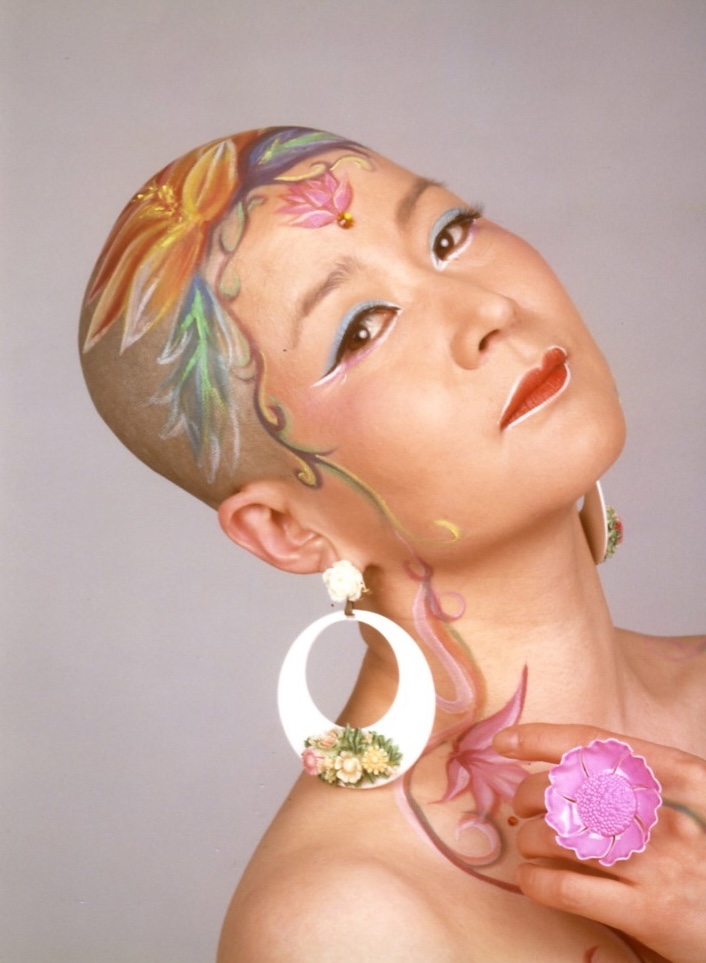
Eun-me Ahn , the Seoul choreographer with the shaved head and brightly colored outfits, is Korea’s choreographic figurehead. Her colorful parallel world reveals itself with force as soon as she opens the door to her rehearsal studio.

Thomas Hahn
Dance journalist in Paris and Seoul

A hurricane of high chromaticism

The path to Eun-me Ahn is reserved for the initiated alone. Her studio in Seoul is well hidden behind a gas station, not far from the Han River. On the right are the gas pumps, on the left a row of gray concrete houses. Behind these, a few steps lead down to the basement.

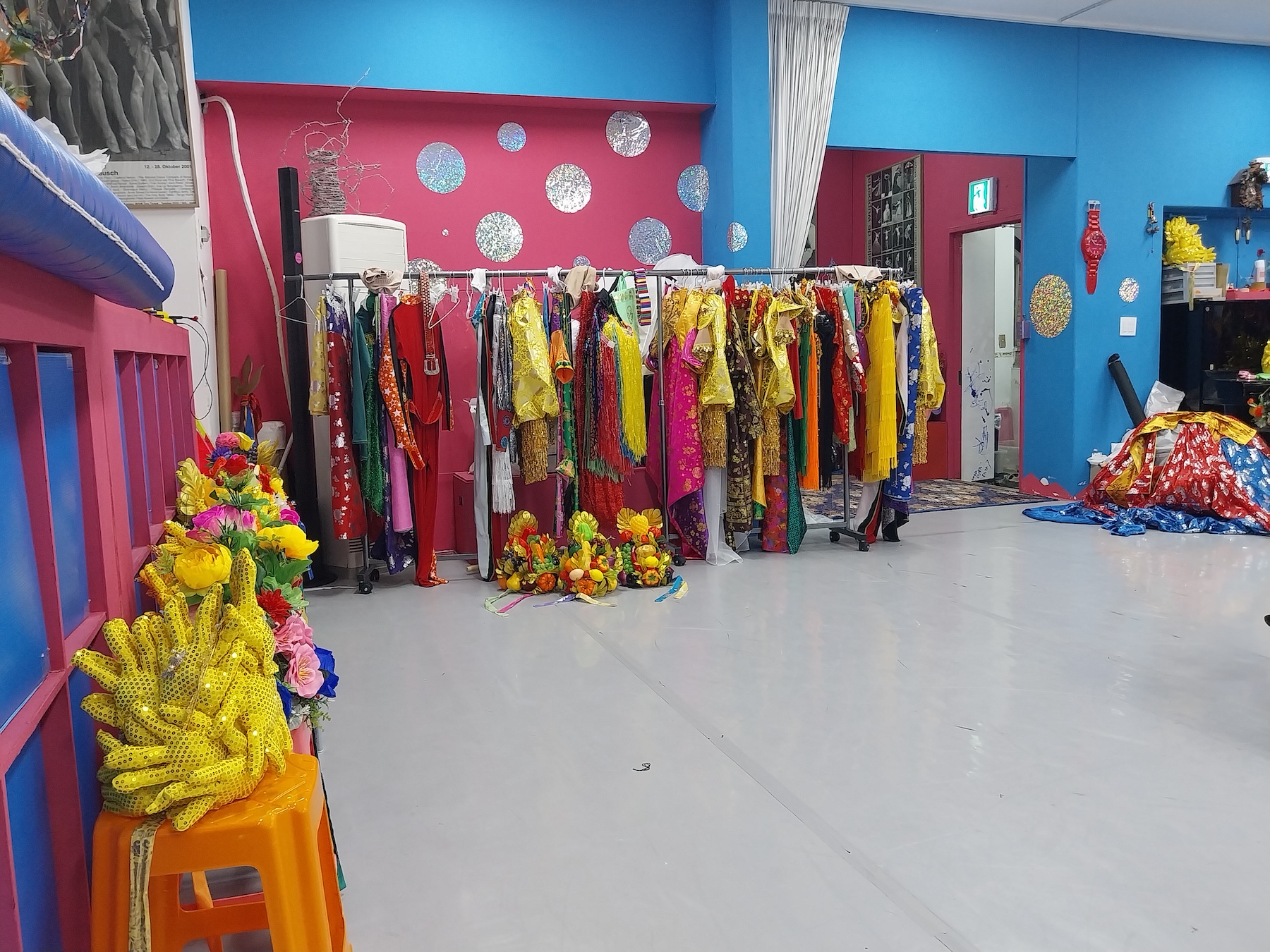
The studio of the Eun-me Ahn Company

Thomas Hahn

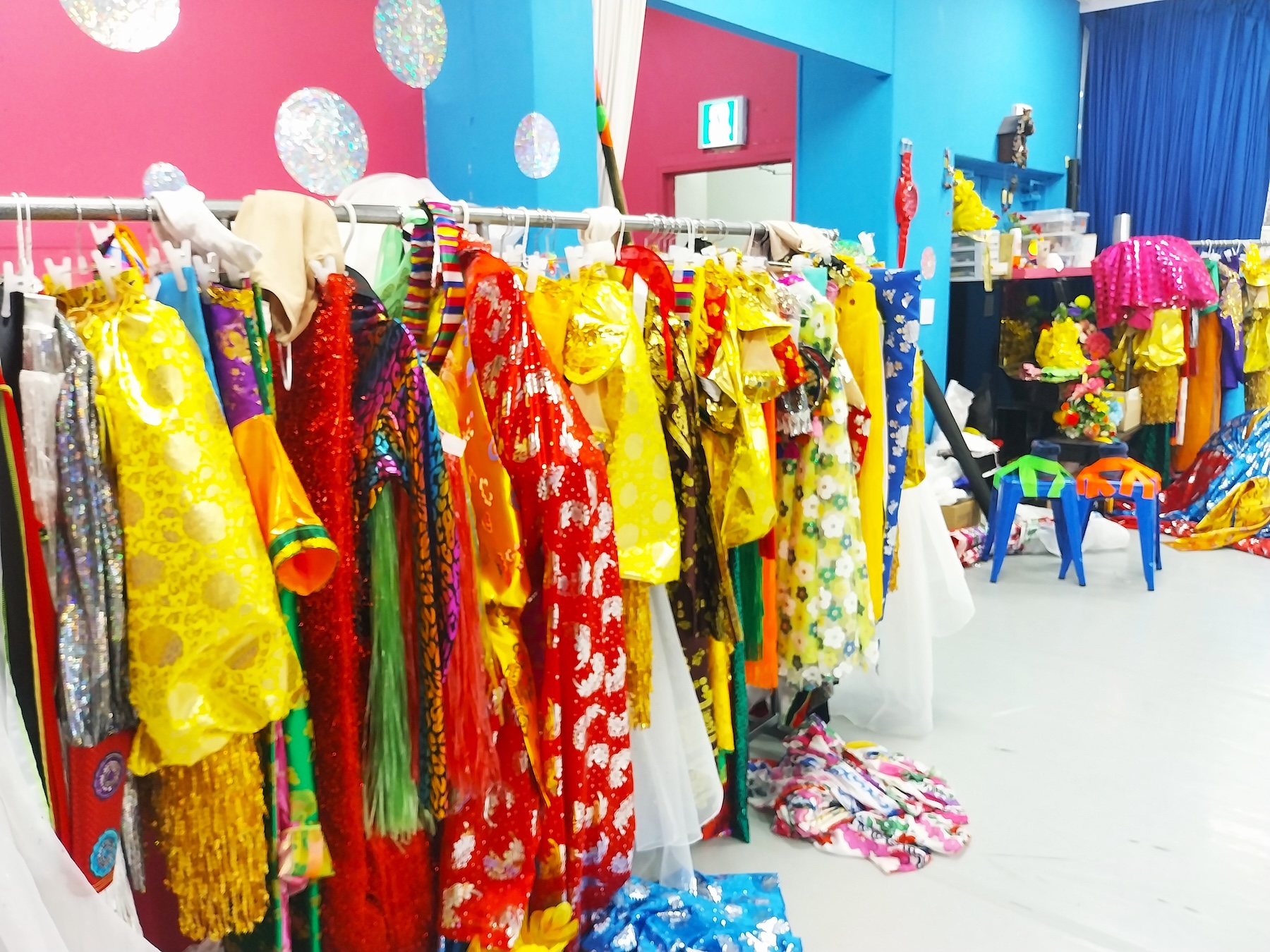
Anyone who opens the right door is simply blown away by the blast of brilliant color that suddenly hits them. The visual hurricane of red, blue, green, and yellow hits you all the harder because nothing else in the surroundings hints at such unbridled colorfulness. Colors are the basis of all Eun-me Ahn’s creativity. Welcome to the vibrant powerhouse of South Korea’s most flamboyant choreographer.

Ahn, with her shaved head, is authentic to the core, free, crazy, funny, and when necessary also sarcastic and authoritarian—one of a kind. The South Korean, who studied in New York and was the first dancer to dare to appear naked on stage in her country, rejects any separation between life and art. In her brightly colored outfits, she seems to spring out of her own pieces. And at any moment, it seems, she would be able to jump back into any of her stage plays.

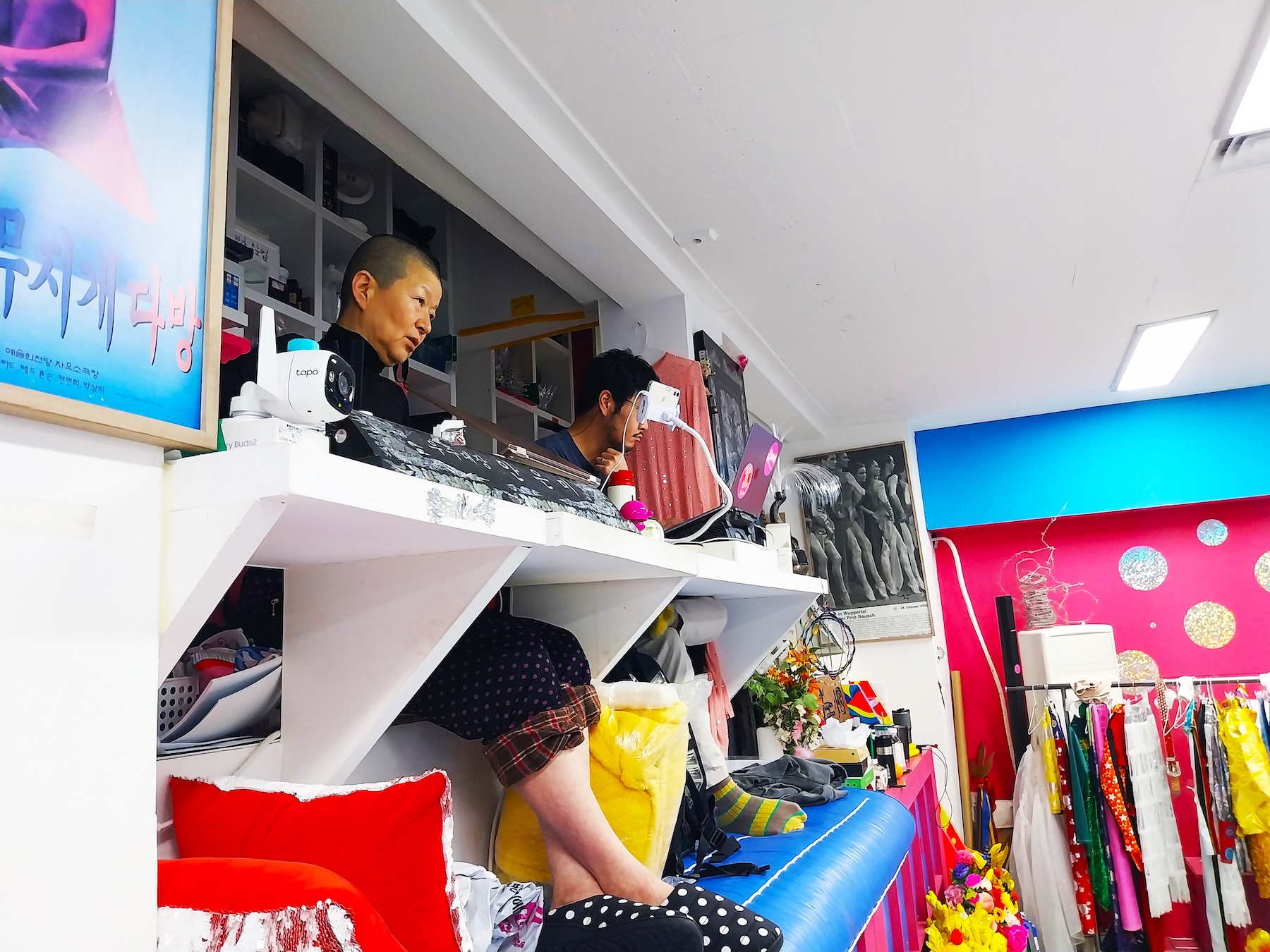
Eun-me Ahn and Sung-bin Kim on their raised hide

Thomas Hahn

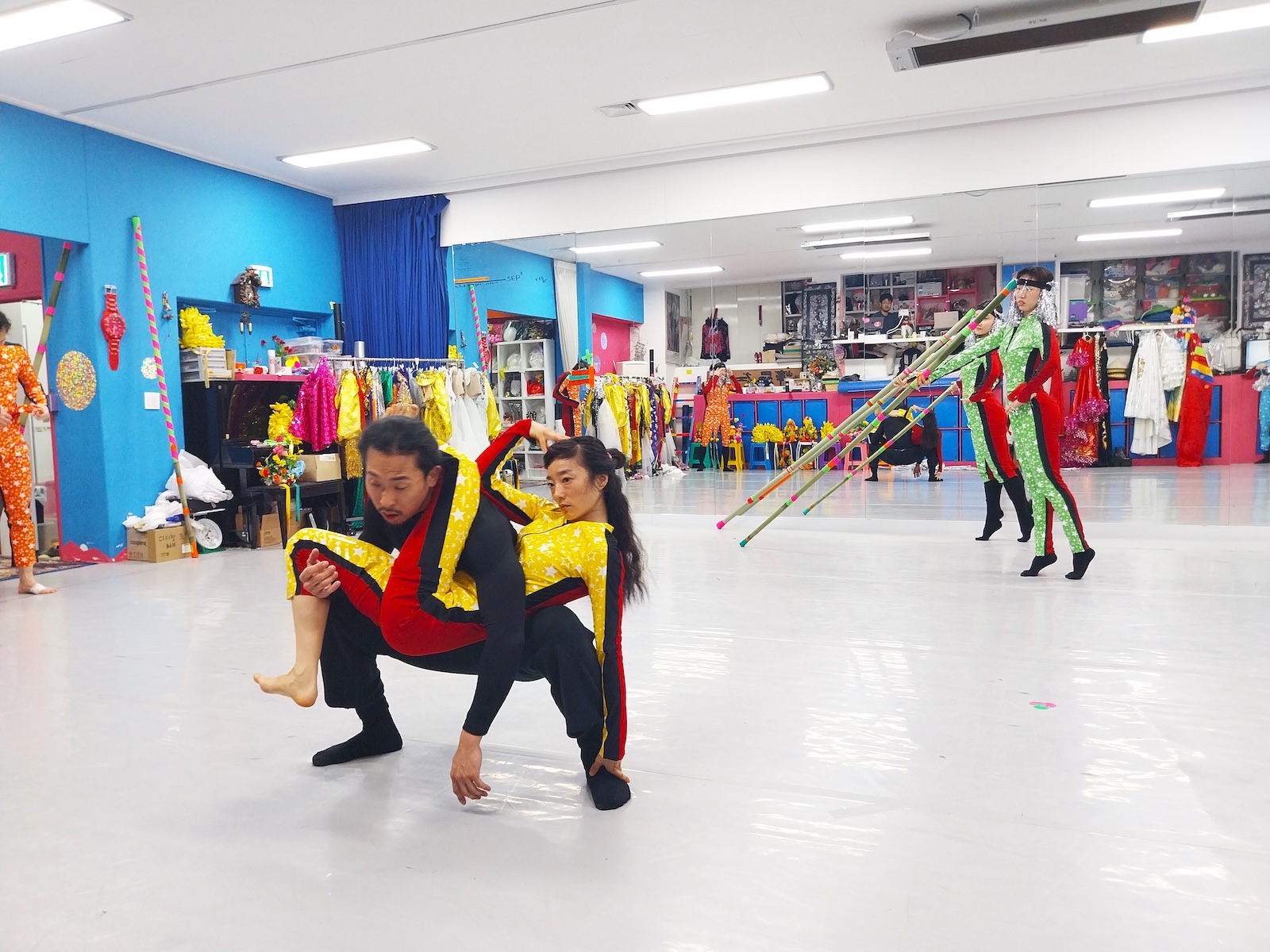
Here in the basement studio, the boss has had a raised seat built on one long side, like a command post from which she observes and directs the dancers. To her left sits her assistant, Sung-bin Kim. Both rest their feet on a blue upholstered bench. Ahn wears polka dot socks; Kim’s are striped. Hundreds of brightly colored costumes hang to their left and right. Ahn designed a good ten of these magnificent dresses per dancer for her latest work, “Post Orientalist Express.” Nine dancers perform on stage. Ninety colorful robes hang next to equally colorful costumes from earlier pieces. Vibrant flower arrangements also demand attention. Here is a strange yellow coral reef made of stuffed gloves, there I see a bunch of plastic stools in pink, purple, and blue. Packages of colorful sequins, clasps, and glass beads glitter everywhere on the floor… The eyes can hardly withstand the storm of colors.

Eun-me Ahn in traditional hanbok

Thomas Hahn

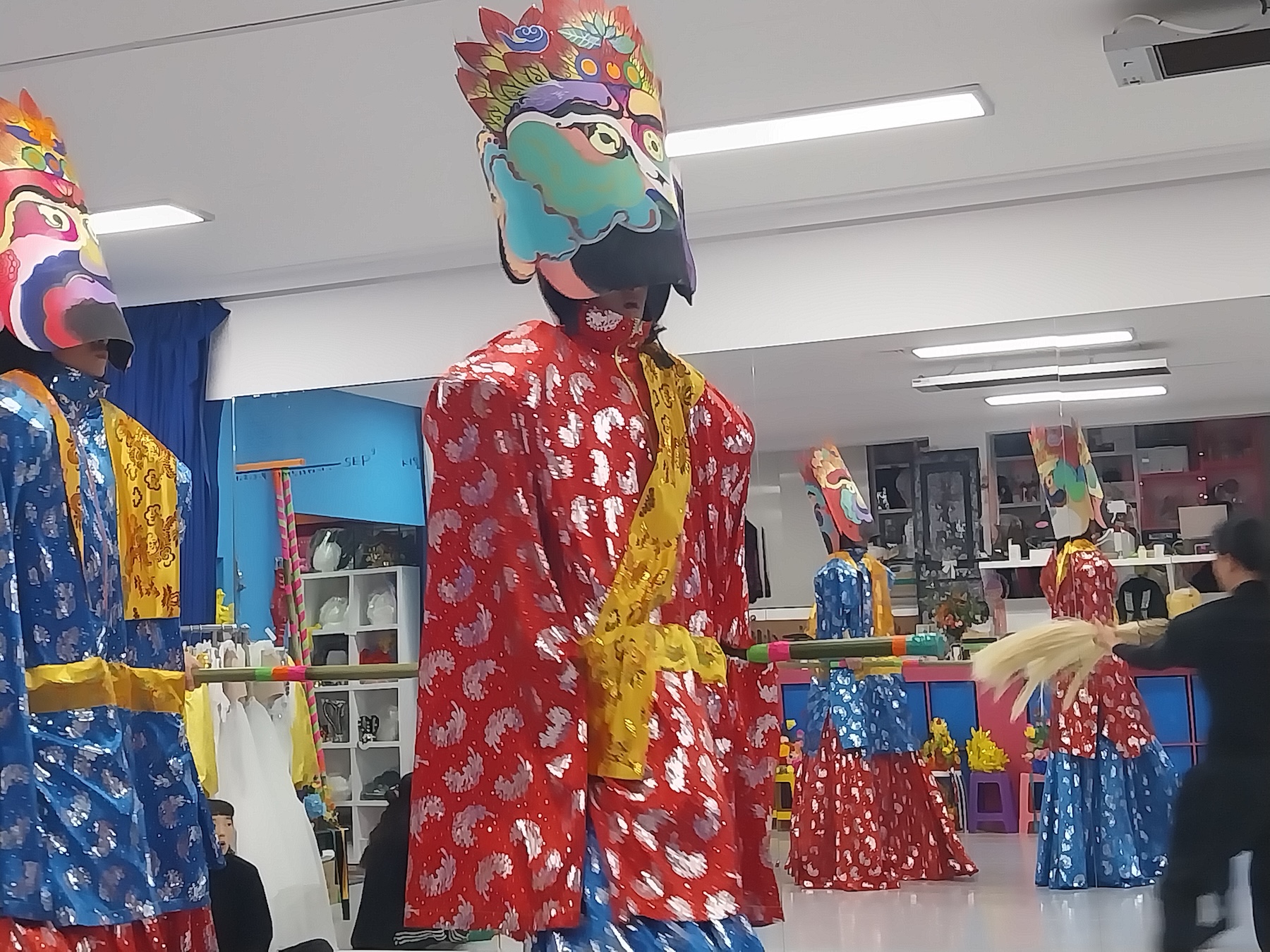
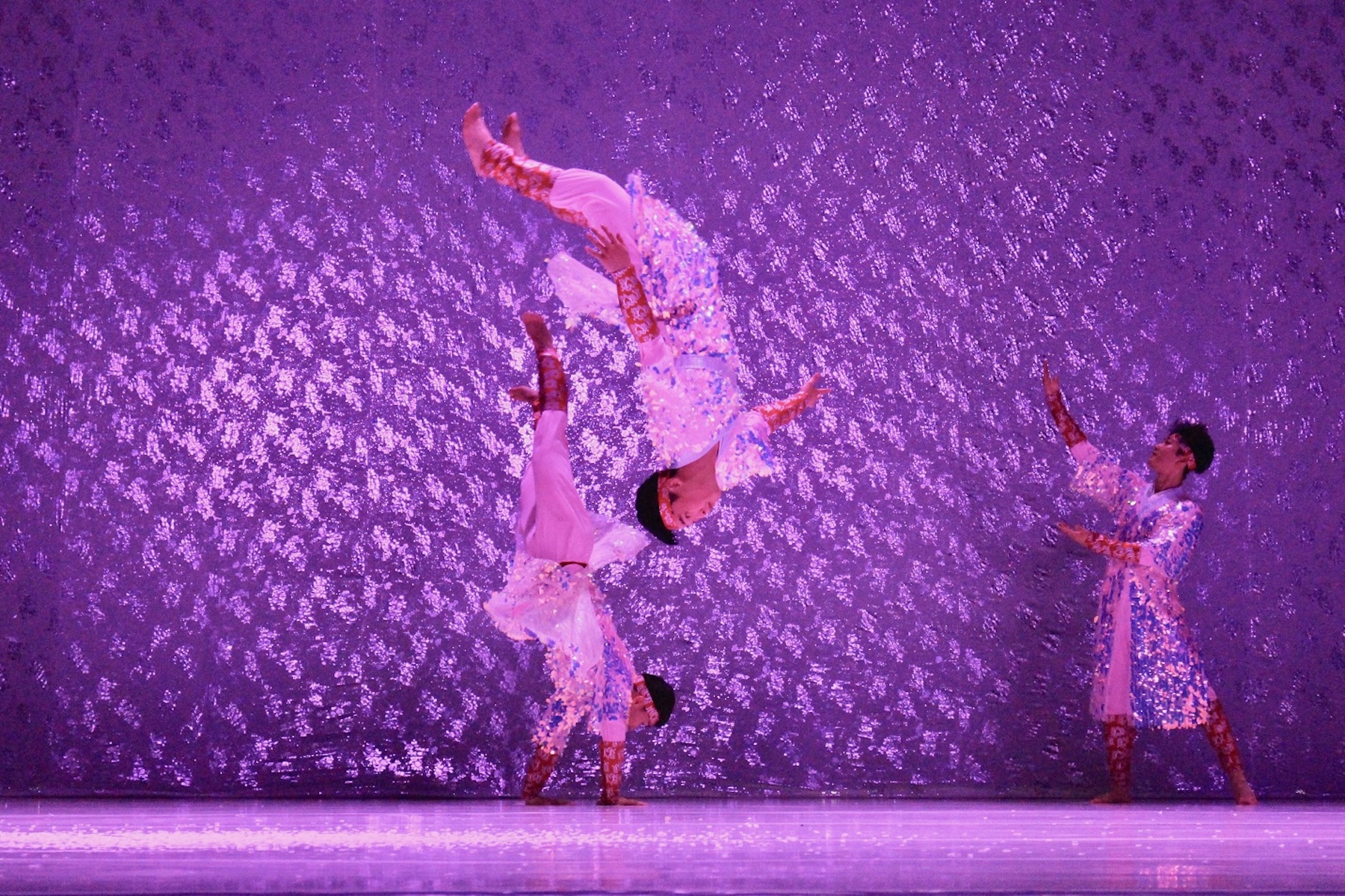
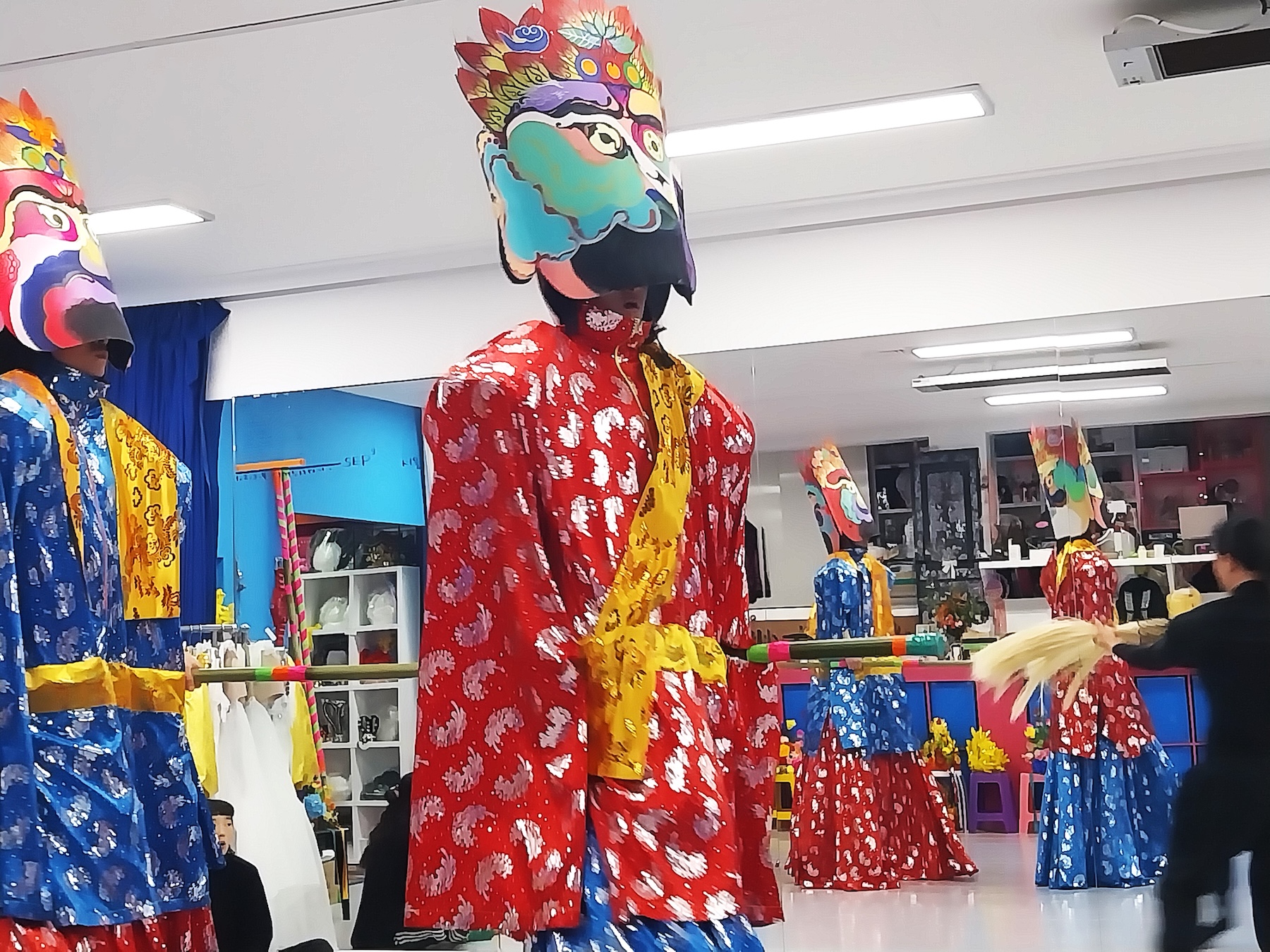
They are currently rehearsing in Korean hanbok printed with silver flowers—a stunning, traditional, voluminous costume from the time when the Mongols ruled. This costume will not appear in “Post-Orientalist Express”: Putting it on is too complicated, and it’s probably too closely tied to Korean folklore. Ahn is more interested in exaggeration, in clichés that are bathed in a whole range of visual stimuli and yet still want to appear authentic.

Samples of “Post-Orientalist Express”

Thomas Hahn

To achieve this, she and her troupe traveled to the Japanese island of Okinawa, Bali, the Philippines, Thailand, Vietnam, and India, always in search of the exotic, clichéd Western view of the Orient— which also includes Turkey and Russia. Everywhere they went, they met dance companies and learned their styles. Ahn was inspired by the local textiles. She issued reciprocal invitations to give workshops here in this studio in Seoul on Asian dances that are unknown in Korea.

“Let Me Change Your Name” by Eun-me Ahn

Marcus Lieberenz/Drama

Land of unity

Her becoming the international figurehead of contemporary Korean dance is due in no small part to Ahn’s openness, but also her uncompromising nature. Her work is completely atypical for the local dance scene. In this society, which allows very little individuality and rejects any eccentricity outright, a colorful character like Eun-me Ahn is naturally the center of attention. Perfectly at home in the role of the enfant terrible, she polarizes in a country where the bourgeoisie tries to blend in with the masses and avoids standing out or offending anyone. This is drummed into people at school and continues at university and in the workplace. The aim is to go with the flow, but still be faster than the others. Standing out in the competitive struggle is the only acceptable way to attract public attention. This culture creates pressure to perform that yields impressive results. But South Korea also has the highest suicide rate of all OECD countries.

South Korea stands out—at least to the rest of the world. The country wants to export its cinema, its pop music, its cosmetics, its electronics, its cars, its refrigerators. South Korea sees itself as a factory and follows its laws. Authenticity is neither desired nor encouraged. Anyone who wants to develop their own choreographic style here has a difficult time. Except for Eun-me Ahn. She happily breaks the mold because many of her pieces address the question of accepting what is different.

‘North Korean Dance’ by Eun-Me Ahn

Jean-Marie Chabot

This includes the dance culture of the country’s worst enemy: “North Korea Dance.” That was the name of her 2018 opus, which emphasized similarities as well as differences. A provocation for everyone, North and South alike. A South Korean production, copied meticulously from video recordings from the North, well seasoned and effectively exaggerating North Korea’s propagandistic dances.

‘Dancing Grandmothers’ by Eun-Me Ahn

Young-mo Choe

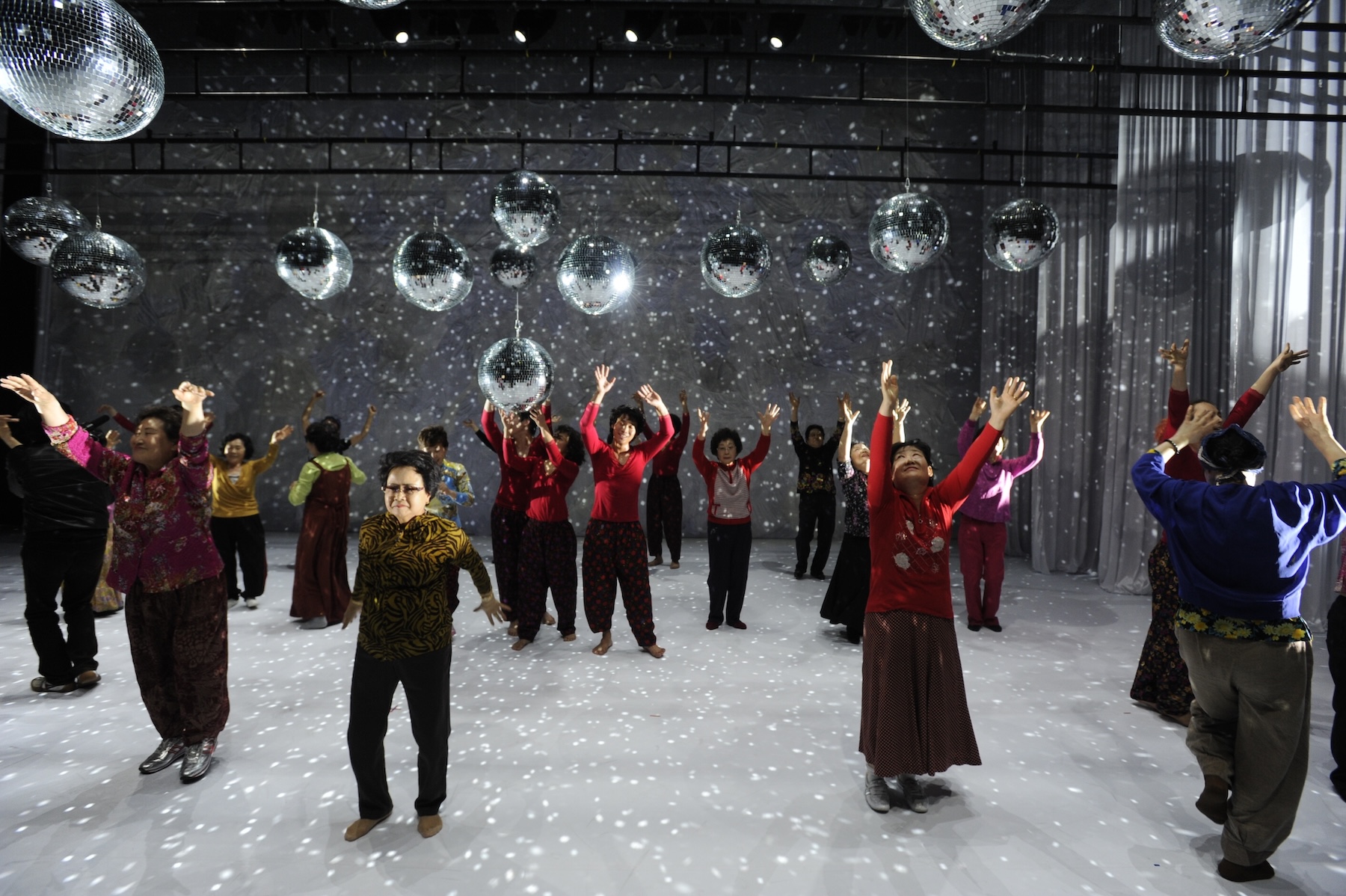
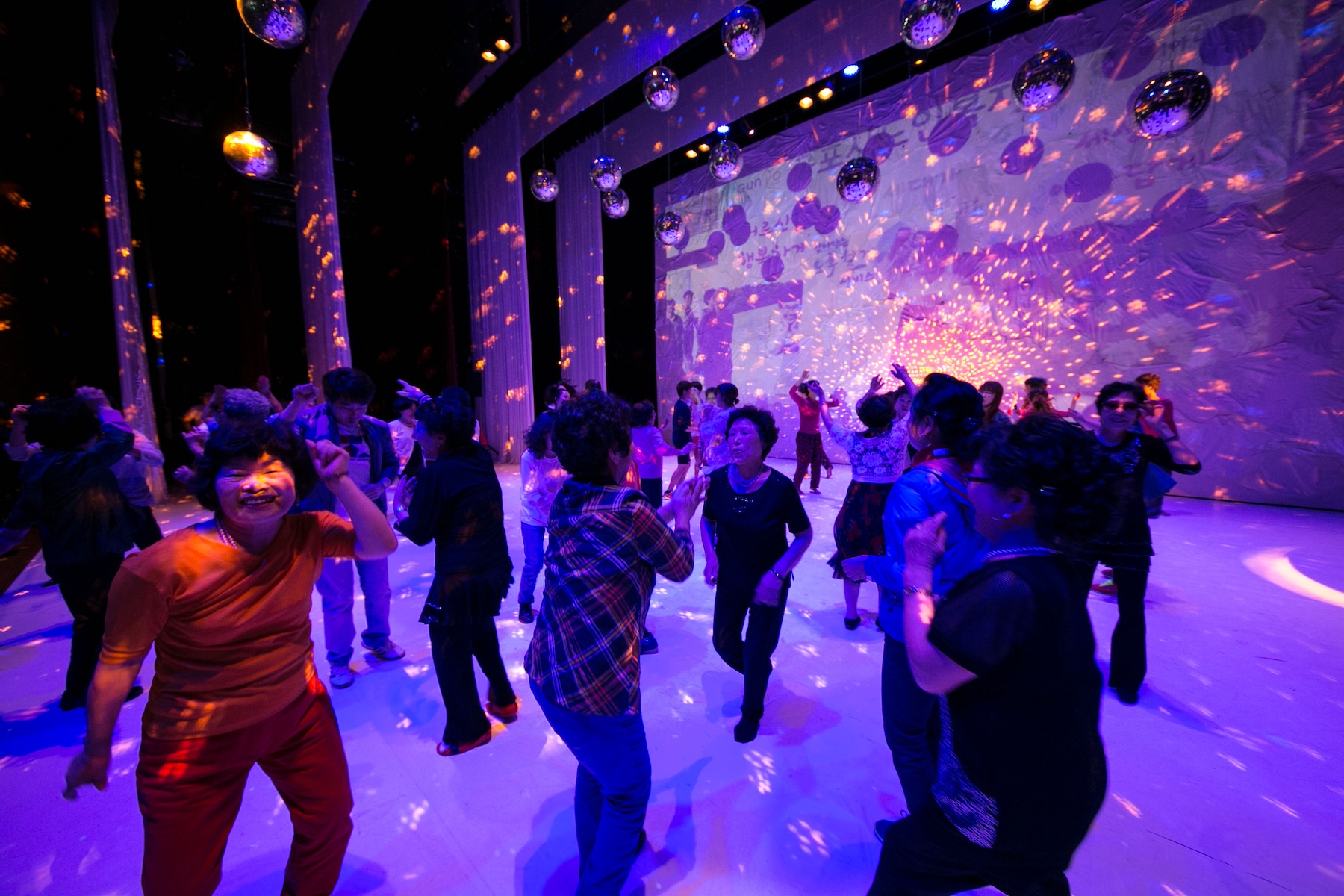
Ahn came to fame in 2010 with a series of reportage-like documentary dance comedies in which she dissected various groups in her country’s society in her own humorous way. It started with “Dancing Grandmothers,” followed by “Dancing Teenteen” and “Dancing Middle-Aged Men.” Ahn was particularly taken with the ajummas, those aging women who devote themselves to their predetermined roles as mothers and grandmothers. Hair always in curlers, they have been part of the Korean street scene since time immemorial. Their neutral clothing and uniform hairstyles signal a departure from a life of sexualized femininity.

“Dancing Grandmothers”

Young-mo Cheo

Ahn traveled through cities and countryside to meet them, film them, and have fun with them. And she discovered that they are much livelier than society’s preferred perception of them. Inspired by Ahn, the ladies began to dance in their everyday surroundings. Ahn filmed them and brought a handful of them onto the stage, where they were allowed to show what they were capable of. She brought them out of their role in the kitchen—although preparing a Korean meal, with its sumptuous banchan (side dishes), is a complex, labor-intensive undertaking that warrants respect.

“Dancing Grandmothers”

Young-mo Cheo

The image of the desexualized elderly is also changing in South Korea. Younger women in Seoul, Gwangju, or Busan expect to continue styling themselves attractively even after motherhood and to order their food online. When it comes to delivery services, South Korean cities are second to none. Whatever you desire can be on your doorstep in minutes. The drivers work to the point of exhaustion—some even beyond.

Democracy and color

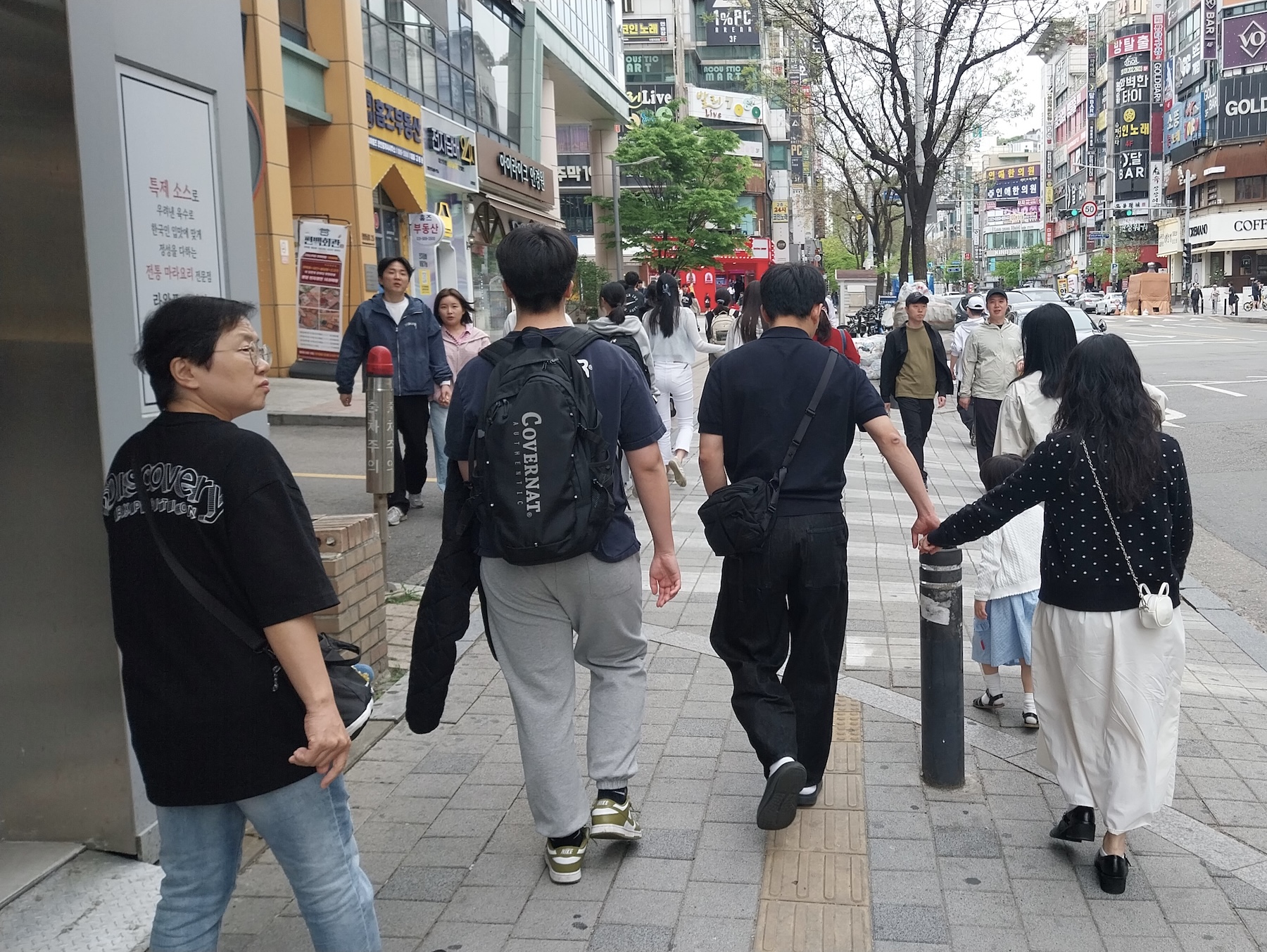
It is no coincidence that the uniform look of the ajummas with their dryer hoods is reminiscent of the victims of a totalitarian system. In North Korea, the party and its supposedly beloved leader Kim Jong Un determine the catalog of permitted hairstyles. There are said to be about ten approved styles. But is the situation in South Korea so different? Young men in particular seem to see no alternative to the look of their K-pop stars. Here, everything revolves around fashion. The word does not necessarily have the same meaning in South Korea as it does in Europe. At home in Paris, I say to my wife, who is from Seoul, “Look, I think these shoes are in fashion now.” She replies, “I wouldn’t have thought so, because only a few people are wearing them. When something is in fashion where we live, everyone dresses that way. If black down jackets are popular in winter, you don’t see any other colors.”

Scene on the streets of Seoul

Thomas Hahn

A glance at the streets of Seoul tends to confirm what she says. Eun-me Ahn’s colorful wit actively resists this trend and makes a political statement: “Color is an expression of individual energy. Colorfulness means thinking differently, questioning boundaries. That is vibrant democracy. But politics exercises a great deal of control.”

Yet South Korean democracy is not in such a bad state. Several former heads of state have been convicted of corruption and brought to trial. But the shock of December 2024 runs deep. It was then that president-elect Yoon declared martial law in a bid to undermine democracy by force. Memories of the military dictatorship are still too fresh, however: The country only became democratic in 1987.

The vast majority are united by the awareness that a democratic constitution is worth defending. It was mostly older people who supported the populist Yoon—the generation that was most likely to wear colorful clothing. When I want to buy green pants in Paris, my wife teases me: “Do you want to look like a grandpa?”

Eun-me Ahn

Sanghoon

Eun-me Ahn recounts how she got into dance: “As a child, I once encountered a group of people on the street who were dressed entirely in green. I was fascinated and followed them. They went into a dance studio. I was overwhelmed by the atmosphere, the exercises, the mirrors. I was dying to join the group. But it cost money, and my mother didn’t have any to spare. I started practicing at home, just for myself. Then I performed little pieces with my friends. It wasn’t until I was twelve that my mother paid for dance lessons: I learned the basics of traditional Korean dance. Shortly afterwards, she enrolled me in an English course and that was the end of dancing. It was only later that she gave me money for dance lessons again. So I enrolled in a contemporary dance program and studied at Ewha Women’s University, graduated with a degree in fine arts, opened my own dance studio, and founded my first company, Paper Steps. The concept was that we would move as if on paper.”

“Post-Orientalist Express”

Jean-Marie Chabot

The politics of K-food

The dance piece “Post-Orientalist Express” premiered at the Sejong Center for the Performing Arts on May 2, 2025. Opened in 1978, the theater is located in the heart of the capital, in the Jongno district, very close to the “Blue House” (the former presidential palace) and the royal Changdeokgung Palace. At the time, the country was in a state of high tension. The Constitutional Court had confirmed the legality of the impeachment of right-wing populist Yoon at the beginning of April, clearing the way for new presidential elections. These were to take place in June, and the social democrat Jae-myung Lee would emerge as the clear winner. On May 1, the day before the premiere, Seoul was the site of trade union rallies that were energetic by Korean standards.

In front of the theatre: a demonstration for the improvement of the situation in the temporary employment sector

Thomas Hahn

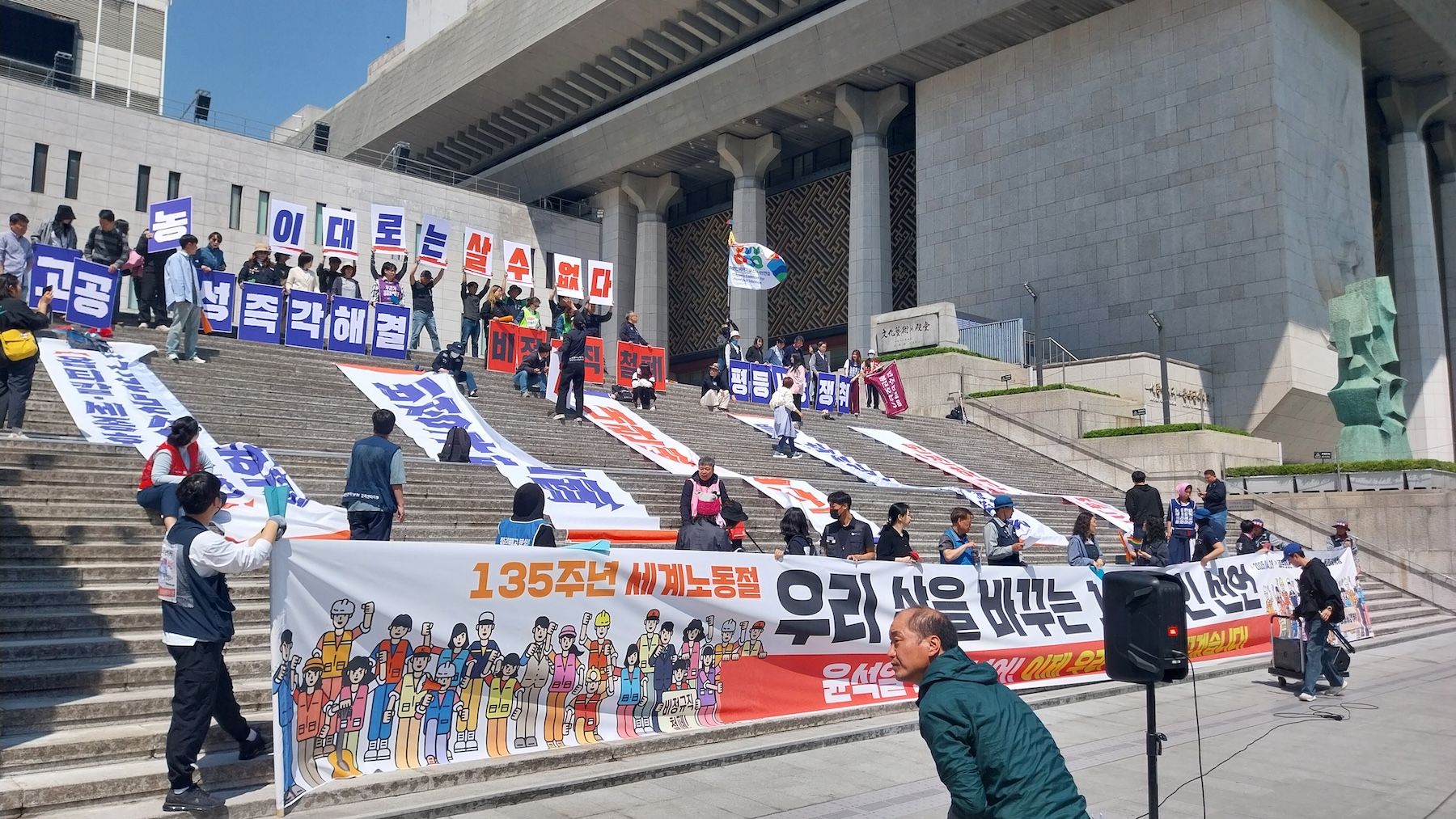
Days earlier, demonstrators had gathered in front of the theater to protest against the situation of temporary workers. But that gathering was overshadowed by a very different kind of demonstration. In large letters visible from afar, a proud statement was emblazoned in red and orange: “K-FOOD.” Koreans themselves would never refer to their cuisine in this way. They eat gimbap or tteokbokki, bulgogi or japchae. Pizza stands remain the exception within the cityscape. “K-FOOD” was a campaign aimed at foreigners who are keen on K-pop and K-dramas (Korean soap operas). The success of these exports has led enterprising parties within the country to simply add a signature K to whatever they’re selling in order to be overrun by crowds of young people. K-beauty, K-fashion, K-books, K-actors… Now even the war industry is booming: K-defense is the next big thing. “Global Hallyu” is the name of the worldwide Korean wave that has washed up from South Korean pop culture and seems to be taking over everything.

The Ambiguous Dance Company in their piece “Fever”

Gunu Kim-uai

But where is K-dance? It seems more likely that contemporary dance in Korea is dissolving into the K-pop wave. This is the case with the Ambiguous Dance Company, which has enjoyed international success since its hit piece “Body Concert,” performed in 2016 in white shirts and black business suits. But it wasn’t until 2024 that the group was able to follow up with a new piece, “The Belt.” The market is too volatile. The highly productive Eun-me Ahn remains the hottest act in Seoul’s choreographic scene.

The studio walls in Korea’s national colours

Thomas Hahn

Looking north

The walls in Ahn’s studio glow blue and red. Blue and red also represent the Korean flag, in both the north and the south—in more solid, dark tones in the north and a lighter, airier version in the south.

“North Korea Dance”

Jean-Marie Chabot

When Ahn presented her piece “North Korea Dance” in 2018, which dealt with dance forms in the northern sister country—a theme that does not fit in with the geopolitical confrontation at all—she quickly realized that the dancers on her stage would not be dressed as colorfully as usual. But so what? You can’t see her art in North Korea anyway. Ahn’s spirit and aesthetics would have such an explosive effect in Kim Jong Un’s empire that her audience, if there were one, would face severe punishment. The regime across the demarcation line would make no distinction between Ahn’s pieces and K-pop although the only thing Ahn’s aesthetics have in common with K-pop is her openness to colorful outfits.

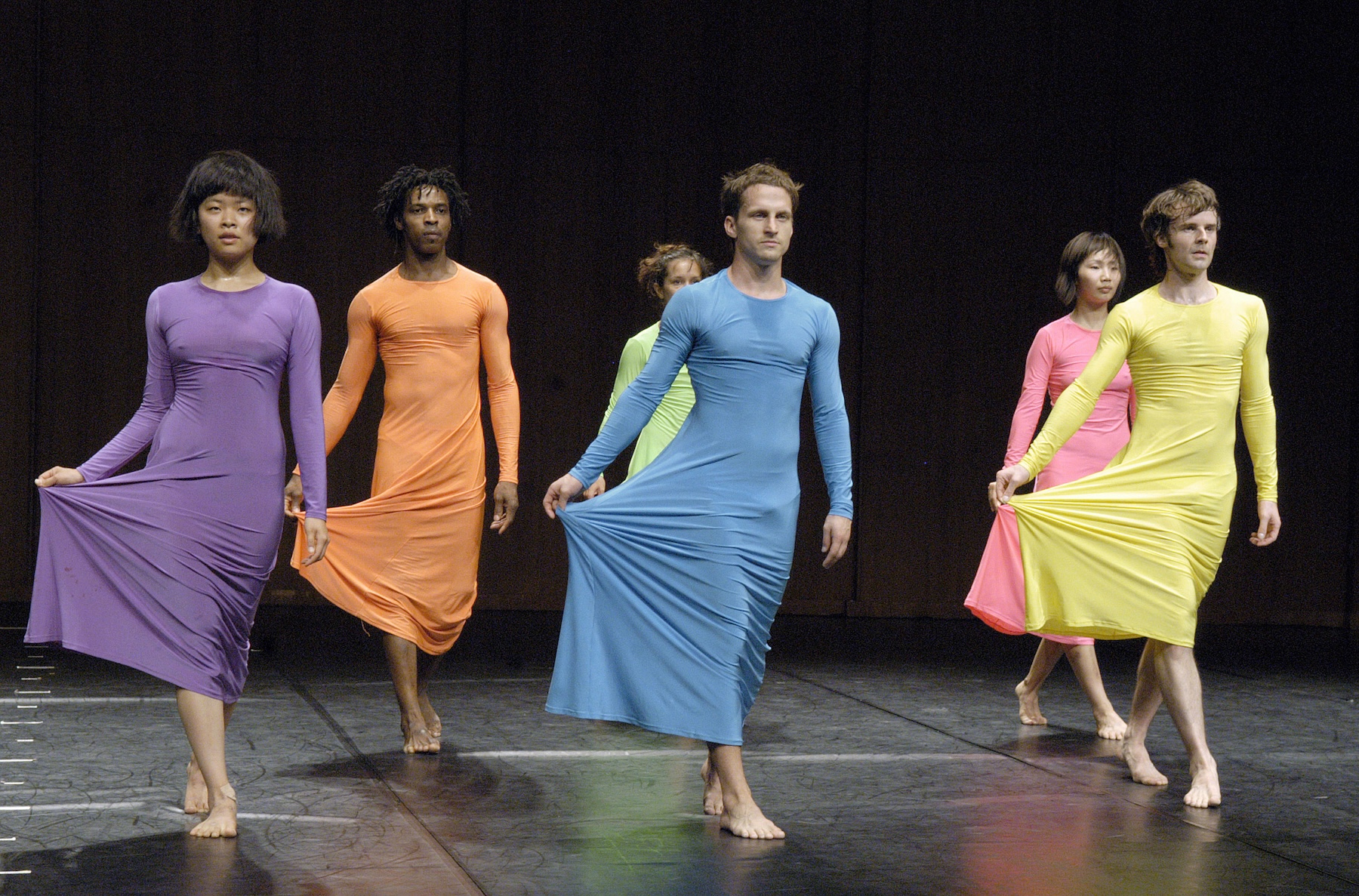
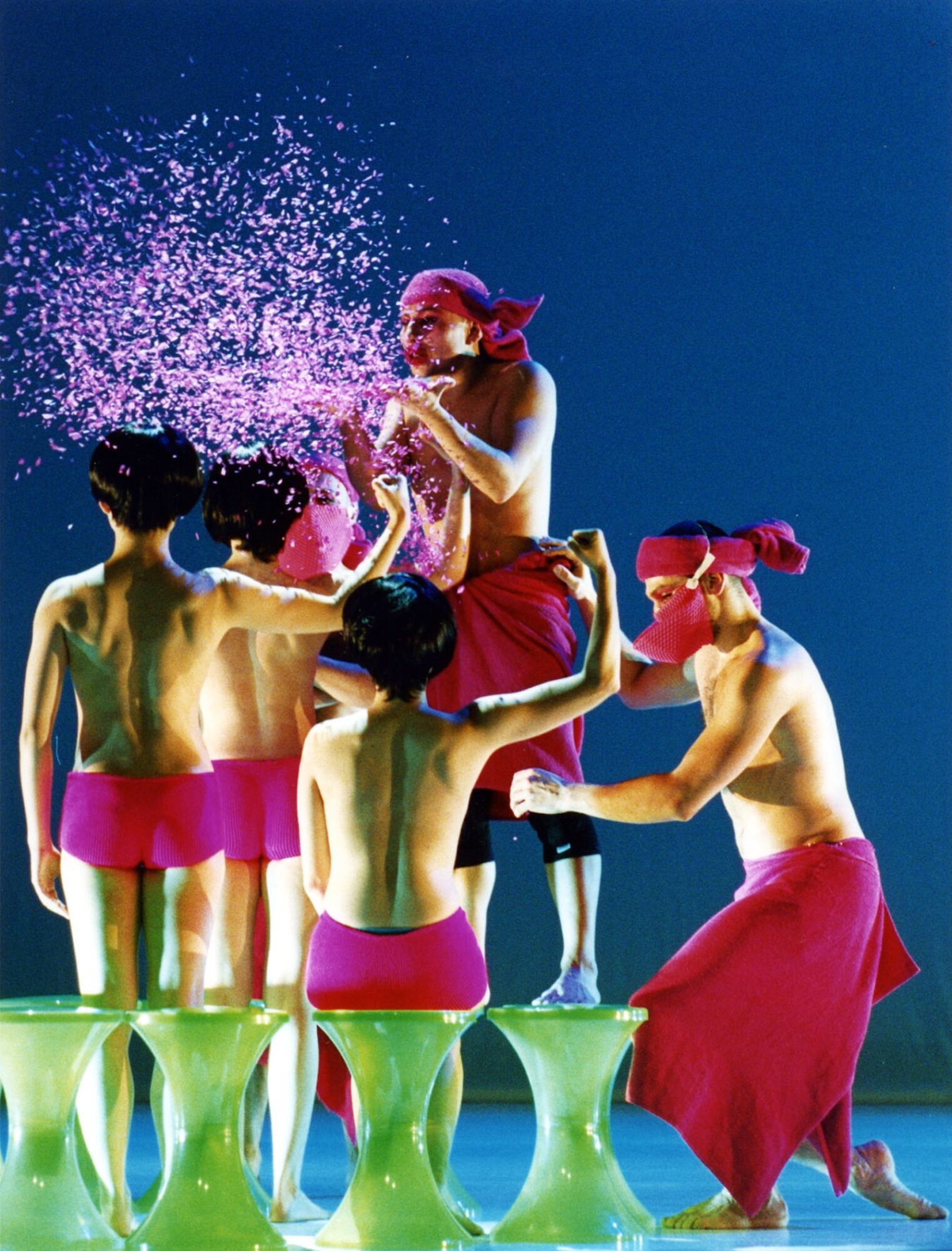
‘Please Hold My Hand’ by Eun-Me Ahn at the Folkwang Tanzstudio in Essen, 2003.

Archive

And even that is much more pronounced in Ahn’s work. In terms of pigments per square centimeter and beats per minute, Ahn’s fireworks beat the products of K-pop producers by a mile.

She has nothing against K-pop and says: “K-pop is quite colorful, it brings more color into public life. But on the street, the picture remains very black and white.” The dividing line between the screen and the sidewalk remains. In the cityscape, the splashes of color are reserved for the lanterns of Buddhism when the streets near the temples are decorated for Buddha’s birthday in early May.

Eun-me Ahn

Despite her shaved head, Ahn is not a Buddhist. At the age of 11, long before she went to New York in the 1990s to study at the Tisch School of the Arts and became familiar with Western contemporary dance, she was influenced by shamanistic rituals. Back home, she became a dancer in South Korea’s leading companies—first the Korean Modern Dance Company and then the Korean Contemporary Dance Company, which still exists today. As more or less the only dance artist in her country with experience abroad, she was a pioneer. In 2001, she was appointed director of the 45-strong Daegu Metropolitan City Dance Company. In 2002, she choreographed the opening ceremony of the World Cup, which was held in South Korea and Japan.

The first soloist Hye-kyoung Kim

Thomas Hahn

A special relationship

One performer in the Eun-me Ahn Company stands out: For eighteen years, she has brought all of Ahn’s personally designed costumes to the stage. Hye-kyoung Kim is a fixture, the danseuse étoile of the company, infected by Ahn’s addiction to colors. “I love bright red, blue, orange, green, and pink. I like to wear them, except when I want to calm down or have something important to do. On official occasions, I hide the colorfulness inside me,” she says, referring to the distinct discretion that makes everyday life in Korea seem so colorless. No one displays their inner feelings in public. Except, of course, Eun-me Ahn.

Hye-kyoung Kim on her colleague and friend: “She is incredibly good at combining colors in such a way that everything seems to glow. They say that mixing all colors inevitably produces black. With her, on the contrary, it creates a lot of vital energy. Her rainbow identity represents the diversity of her career and her art. You never know which direction she will take next. She is so insatiably curious about everything and all kinds of people. She always seems wound up, always on the move, like a rabbit, as if she were in the middle of the story of Alice in Wonderland.”

Eun-Me Ahn in Let Me Change Your Name (2005).

Marcus Lieberenz/Drama

The choreographer is like a mother to her, says Kim: “We live in the same building. Eun-me on the ground floor, me on the second floor. We have breakfast together and spend most of the day together. We laugh and travel together, we argue, then we make up and dance together.” The atmosphere here is reminiscent of Pina Bausch—the studio décor alone makes me think of Wuppertal. On one side of the entrance door hangs a cuckoo clock, opposite a black-and-white poster: “A Festival in Wuppertal.” Bausch invited the Korean dancer to perform her solo pieces there in 2001 and went on to open her stage to her again in the years that followed. The audience in Wuppertal was one of the first in Europe to discover Ahn’s masterpieces.

Traces of the close relationship to Pina Bausch in her studio

Thomas Hahn

They remained true to each other. In 2018 and 2019, Ahn was a member of the three-person jury for the selection of the Pina Bausch Fellowship for Dance and Choreography. Ahn and Bausch held each other in high esteem. Both had to deal with hostility from their audiences for a long time. Over time, Bausch managed to become a fixed star in German society. Despite her ballet directorship in Daegu and involvement with the Olympic opening ceremony: Eun-me Ahn always stayed away from institutions. There will probably never be an Eun-me Ahn Center in Seoul like the one being planned to honor Pina Bausch in Wuppertal.

Fashion and mobility

The Highway of the Same

Thomas Hahn

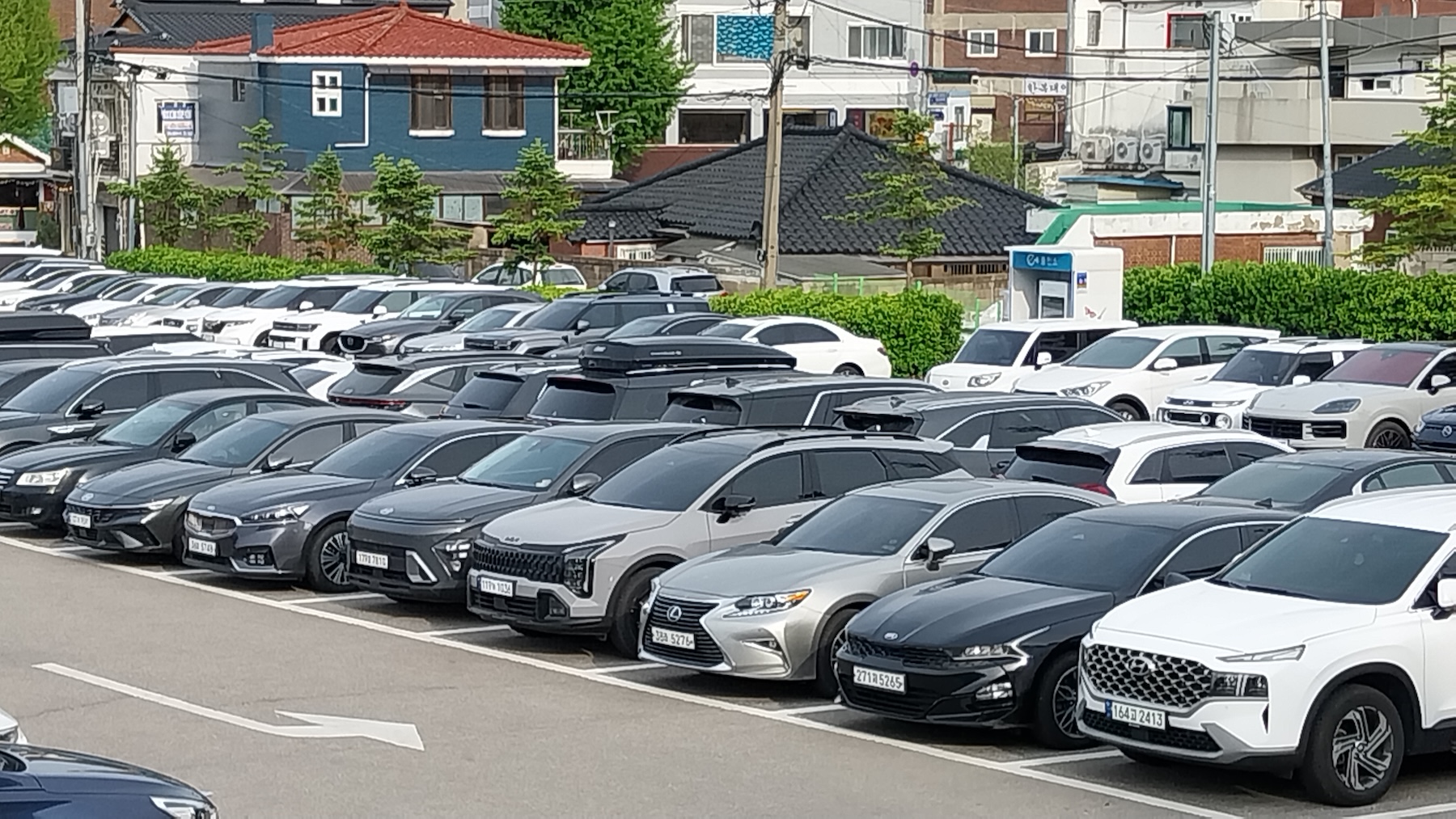
In Seoul, Ahn demonstrates strength through her courage to be colorful in a street scene dominated by colorless limousines. Her first soloist, Hye-kyoung Kim, follows suit: “I drive a pink scooter and Eun-me drives a green car,” she says. Finding a colorful car in Korea is like looking for the proverbial needle in a haystack. A car has to be white, gray, or black; a sedan, but please not a small car. And certainly not beige. When you see a purple Lamborghini speeding through the streets of the slightly eccentric port city of Busan, the effect is striking. Lack of color is non-negotiable in South Korea: “If you have a colorful car, how are you going to sell it on? You can’t even sell a door as a spare part!” a friend explains to me.

A South Korean car park in front of a supermarket looks exactly like this as seen in the delivery depot of a car manufacturer in South Korea.

Thomas Hahn

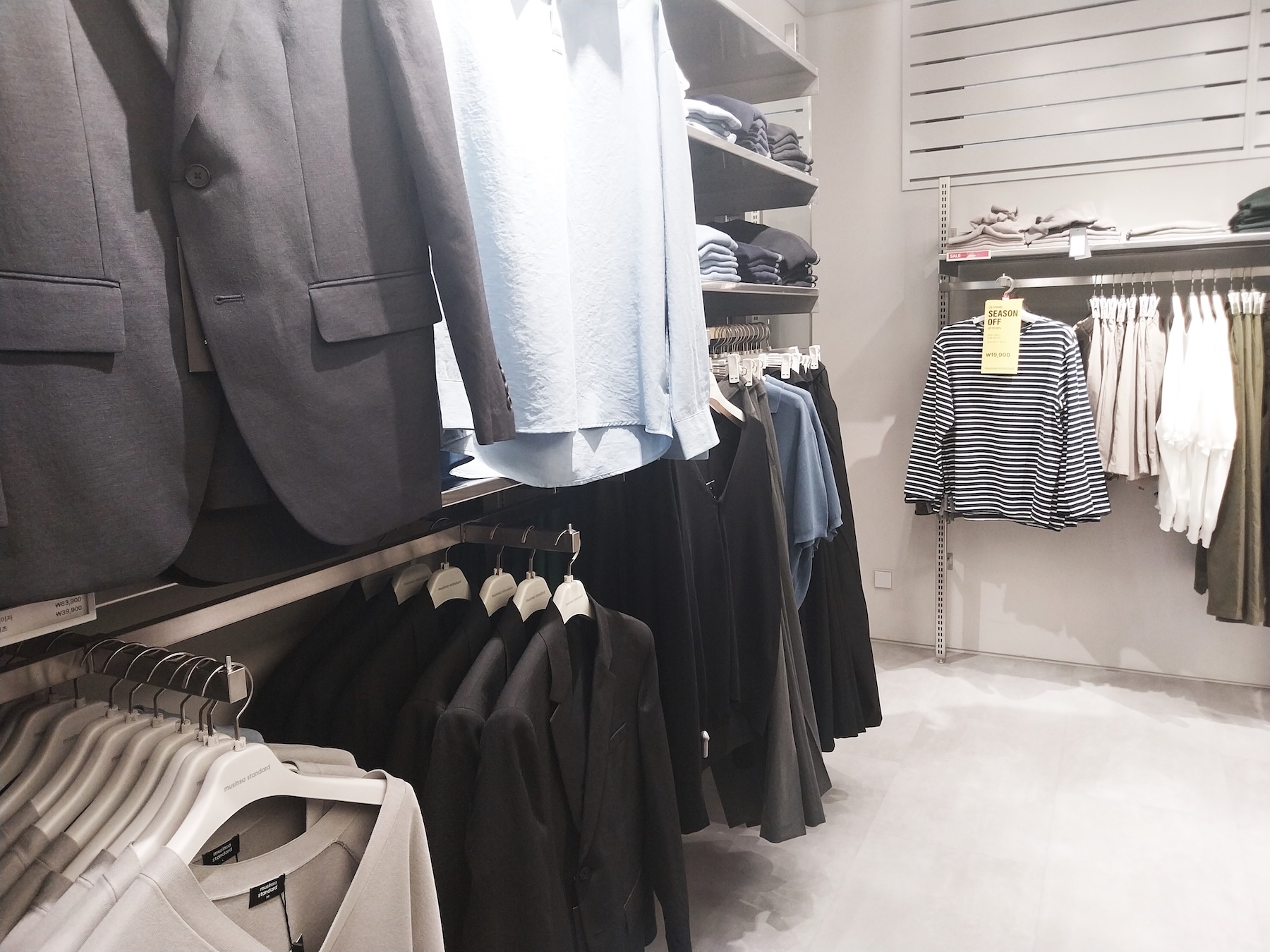
The Musinsa fashion department store, a brand currently popular with urban youth, is located on the hipster-friendly shopping street of Hannam-dong. Its displays feature a palette of gray and sepia tones. Bleak.

Thomas Hahn

The gray of the economic miracle?

It’s about nothing less than cultural harmony. It starts with the name. Sung-bin Kim, the assistant, has the same last name as the first soloist, Hye-kyoung Kim. Two other members of the nine-person production team and a total of three of the nine dancers also go by the name Kim, and it is shared by about 21 percent of the population. Kim means gold. The name is the statistical frontrunner, followed by Lee. Only three hundred patronyms are known to exist in the country. Ahn is also one of the more common Korean surnames.

“Post-Orientalist Express”

Jean-Marie Chabot

This Korean uniformity has to do with the Confucian-influenced pursuit of harmony. Eun-me Ahn doesn’t seem to fit in here. While no one in South Korea has anything against colorfulness per se, the pressure to conform is immense. “In the past, colorful fabrics were reserved for the rich, ruling class. Today, colorfully printed textiles are accessible to all segments of the population,” explains Ahn. The fact that people still dress in drab colors in public, almost like Buddhist monks, could be linked to South Korea’s economic miracle of recent decades. A higher, common goal paved the way for material prosperity in a conformist environment. Individual development and self-realization beyond material desires are unknown in South Korea. At the end of October 2025, the Centre Culturel Coréen in Paris opened a very colorful art exhibition entitled “Couleurs de Corée,” featuring works by stars of contemporary art there, such as Ungno Lee (1904-1989) and Tschang-yeul Kim (1929–2021).

Colorful fruit arrangements in “Post-Orientalist Express”

Sukmu Yun, Jiyang Kim

Gas station in the ice district

As colorful as people’s self-perception is, their attitude in their own external presentation is just as chromatically tactful. When Eun-me Ahn transposes her cheerful inner world into real life, the impression of a surreal parallel world emerges. Like this outrageous colorfulness in Ahn’s rehearsal studio. Every time I visit, I am amazed all over again. The contrast with the outside world could not be greater. Her refuge looks like it should be located in a bustling, densely built-up nightlife district littered with garish, colorful advertising, where restaurants and shops rub shoulders horizontally and vertically, but that is certainly not the case. And even those streets that define our image of Asian cities—colorful islands that stand out from the urban agglomerations—are strictly organized in accordance with hierarchical rules.

Ahn’s studio is located opposite a gray concrete elevated road that crosses the infinitely wide Hangang River and flies over a district that bears the historical name Seokbing, a reference to the ice factories and chambers that former rulers built here. The coolness of the river was used to preserve ice reserves underground. Here, along the city highway, lies one of the last historic districts that has not yet been replaced by residential towers. Seokbing is something of an idyll in a hilly landscape, where mostly older people live in small, low-rise residential buildings. Young professionals prefer the forty-story skyscrapers, which offer spacious, modern apartments and are grouped together in pleasant parks with playgrounds and fitness trails—and are, of course, outrageously expensive. In the winding, sometimes steeply ascending alleys of historic Seokbing, an old lady walks her dog. When someone calls out, “He’s cute!” she barks back, “You don’t have a dog, do you?”

To get from old Seokbing to Eun-me Ahn’s studio, you have to cross the playground under the city highway. If it weren’t for the few trees and the red taillights of the cars, you’d think you were in a black-and-white movie. There’s a café that also sells bicycles. Then the gas station. And at the back, on the left, the staircase that leads to the studio in the basement. This is where South Korea suspects poverty to be, as depicted by Bong-joon Ho in his film “Parasite.” Those who are poor live in the basement. Ahn doesn’t care. The basement protects her from the effects of the real estate bubble, which is causing housing prices to rise to ever more dizzying heights. In response, politicians made promises of a rent cap, which ensured the short-term success of populist Suk-yeol Yoon until his removal from office in April 2025.

Eun-me Ahn praises the landlord who owns her studio: “Twenty years ago, he promised me he would never raise the rent, and he has kept his word to this day.”

A post-Orientalist cocktail

In the politically tense atmosphere of spring 2025, the studio was the perfect retreat. The warm, visually overheated nest is the ideal environment to shield oneself from the outside world. Dancer Hye-kyoung Kim believes that Korean society is becoming increasingly polarized: “It’s getting more and more extreme, on all levels.”

When Yoon attempted to occupy the parliament in the middle of the night on December 3, 2024, the company was on tour in the UK. All of Korea, whether at home or elsewhere in the world, followed the event in disbelief via the media. “Yoon wanted to impose martial law, and I felt as if I had been personally violated,” recalls Hye-kyoung: “In a democratic society, the use of the word itself already constitutes coercion. And it’s related to my history. My father was in the army. Anything to do with the military or that kind of control over others is traumatic for me. People should dance with each other instead!”

That is also the message of Ahn’s pieces, whether in ”North Korean Dances“ or in “Dragons,” the predecessor to “Post-Orientalist Express,” in which Ahn brought together young Generation Z dancers from various Asian countries who expressed their visions and fears for the future through dance.

In “Post-Orientalist Express,” it’s exactly the opposite. The dancers are all from Korea, encountering Far Eastern dances and motifs.

Asian mask dances and a troll at rehearsal

Thomas Hahn

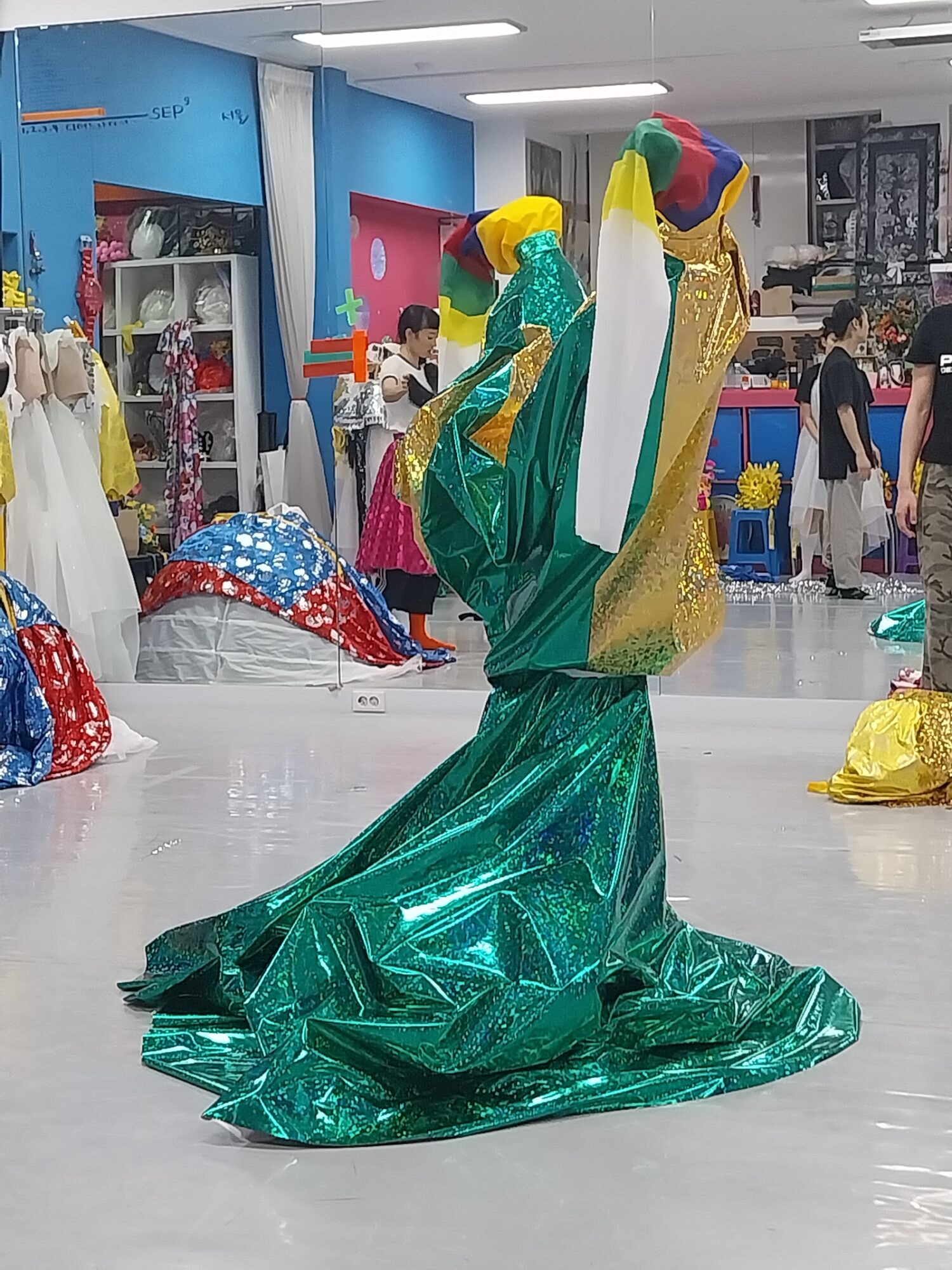
Masks and costumes develop a pan-Oriental opulence, with the company constantly changing costumes to conjure up a different dance form: here a Balinese ceremony, there Kathakali from Kerala. Indonesian Topeng meets Vietnamese fan dance and Sonbo stick dances from Okinawa. A dancer disappears in a dark green bodysuit and spins on his head as if he were a troll.

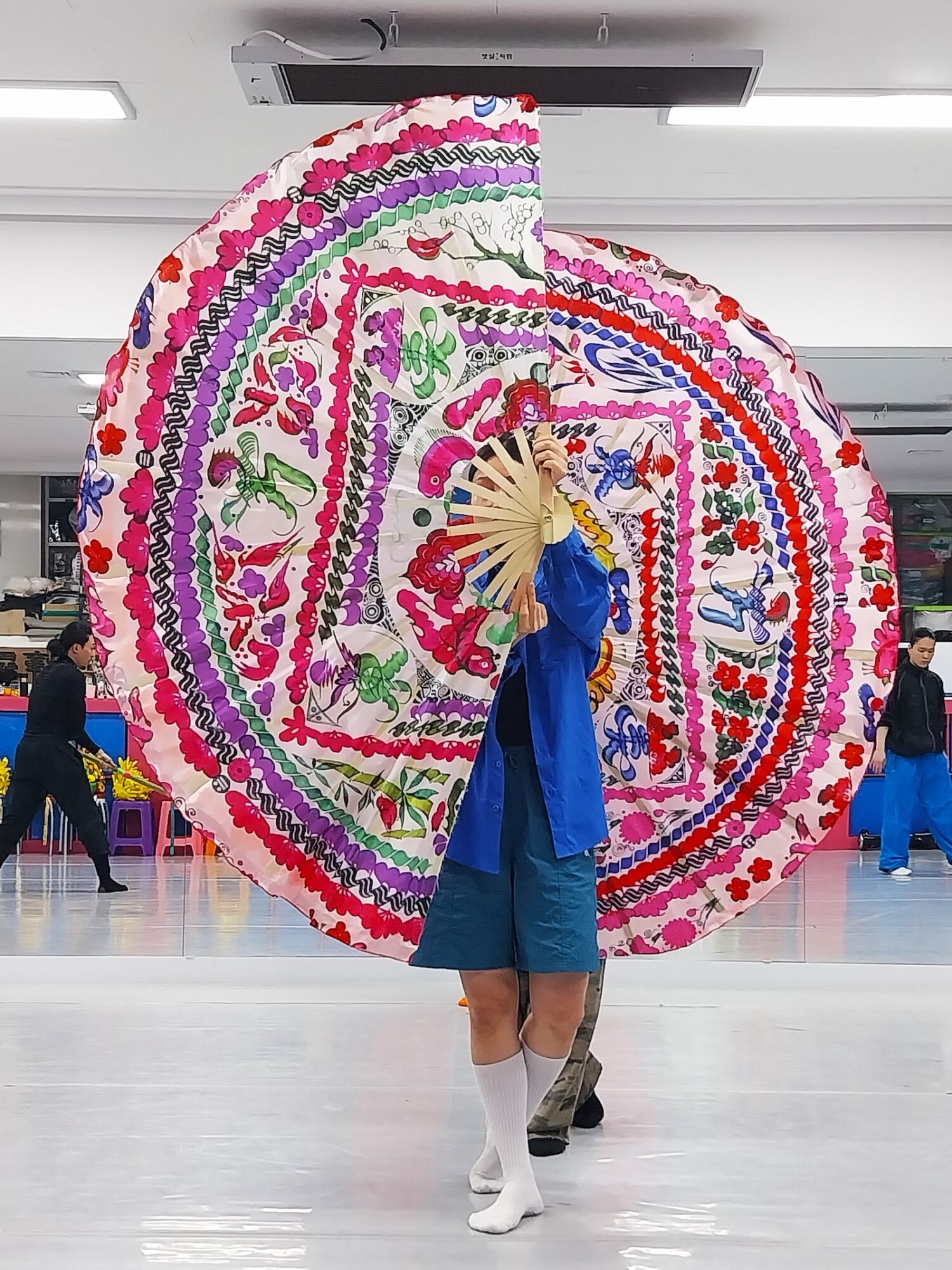
Appearance of the fans

Thomas Hahn

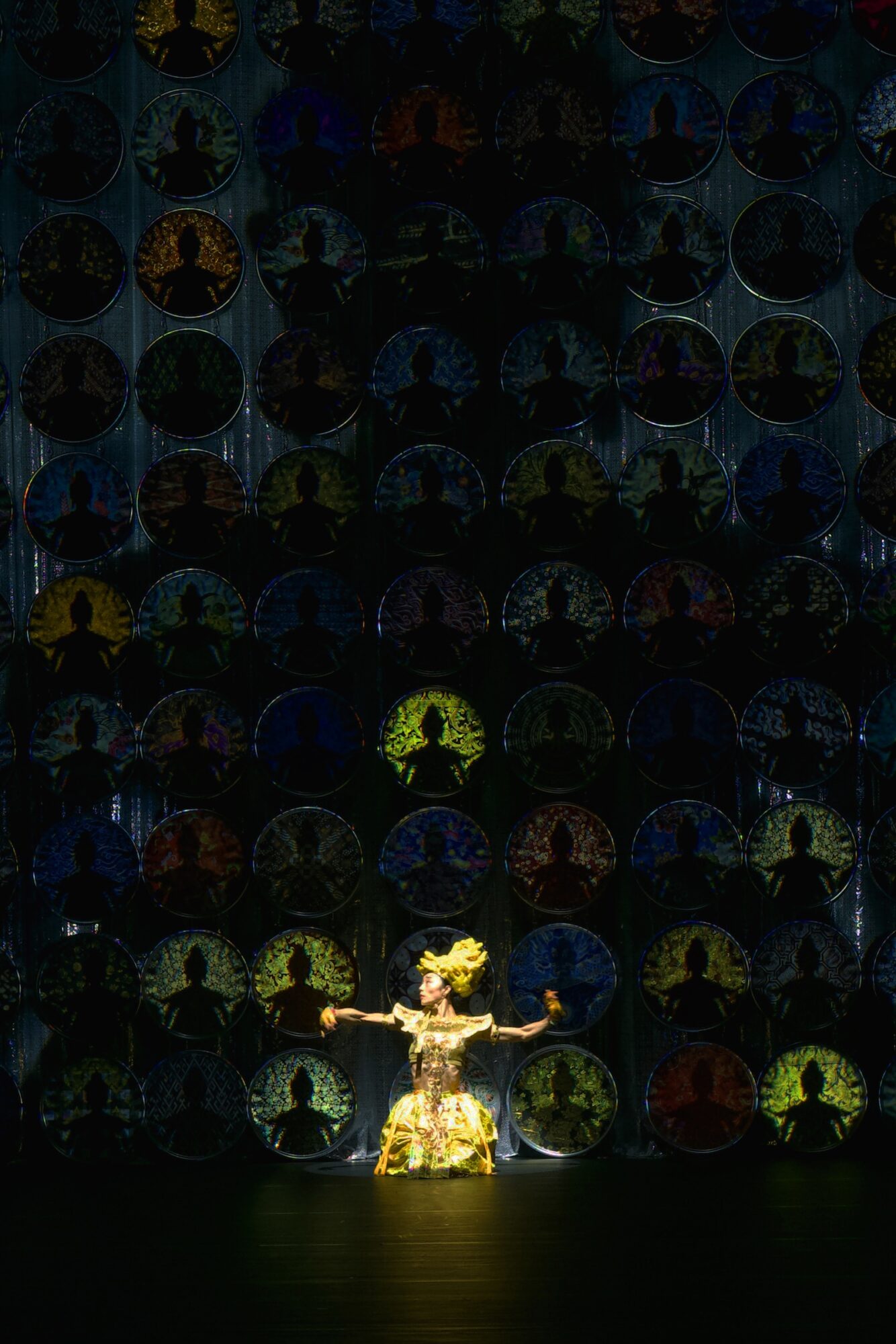
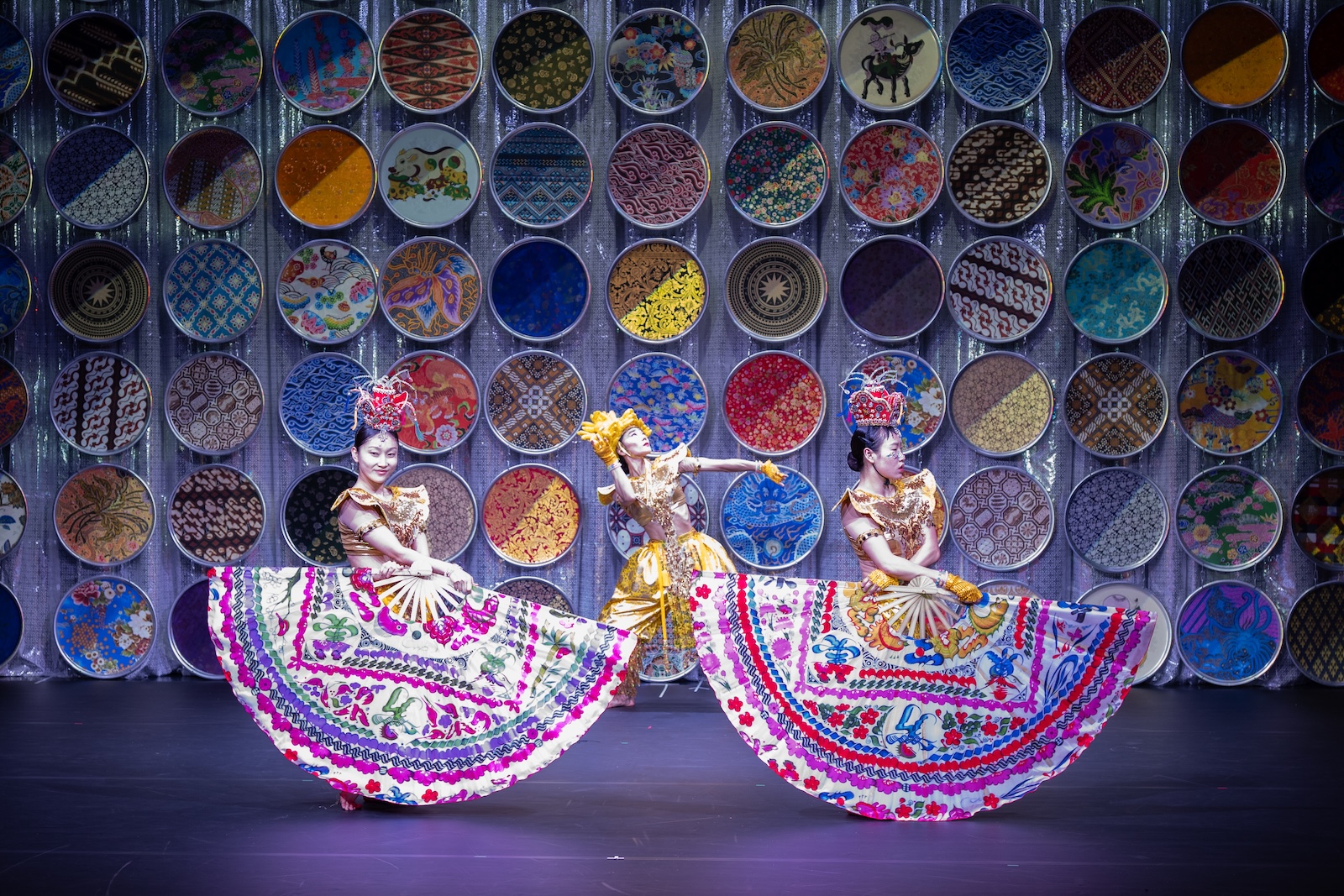
Fans spanning two meters in diameter shine red at the back and white at the front. The costumes are pale green with star motifs on the front and dark red on the back. And the fabrics for the cloth dances are dipped in the pastel colors of the traditional Korean hanbok, their lightness embodying the opposite of this multi-layered costume. Hye-kyoung Kim’s bodysuit, studded with white stars, is bright yellow. She puts on golden yellow glittering gloves, originally used in Buddhist dances, to guide her hands with great calm and silence. “It’s a prayer ritual,” says Eun-me Ahn, “where everything is gold, gold, gold. But we speed up the music and thus also the movements, creating a different dynamic, a new force and completely different images.”
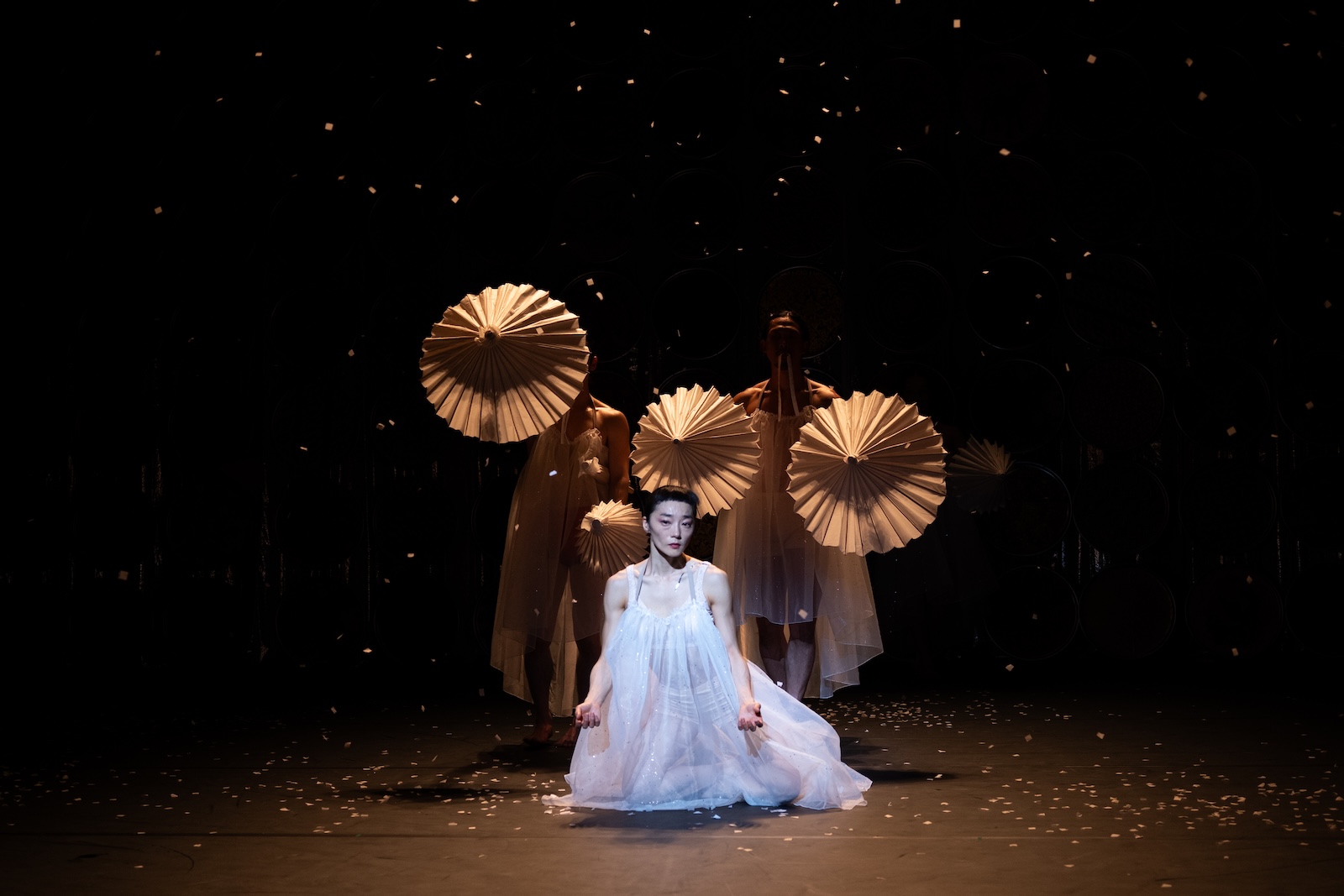
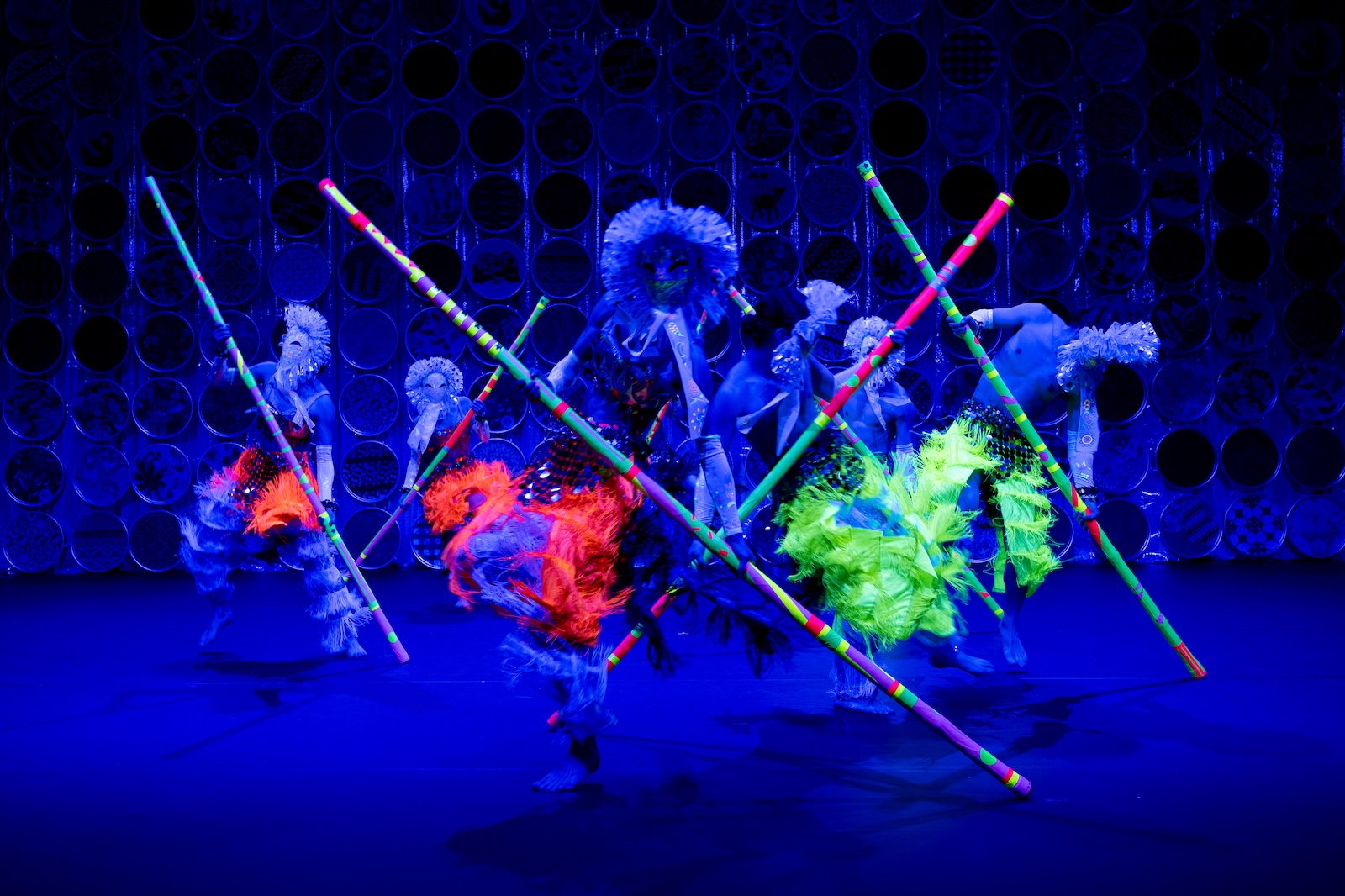
Stick dance in “Post-Orientalist Express”

Jean-Marie Chabot

This is followed by a dance with colored sticks as long as those used for pole vaulting. “In the Philippines, there is a similar dance with bamboo sticks. The symbolism of bamboo is the connection between heaven and earth: a kind of antenna,” says Ahn.

Hye-kyoung Kim will be protected

Jean-Marie Chabot

White femininity

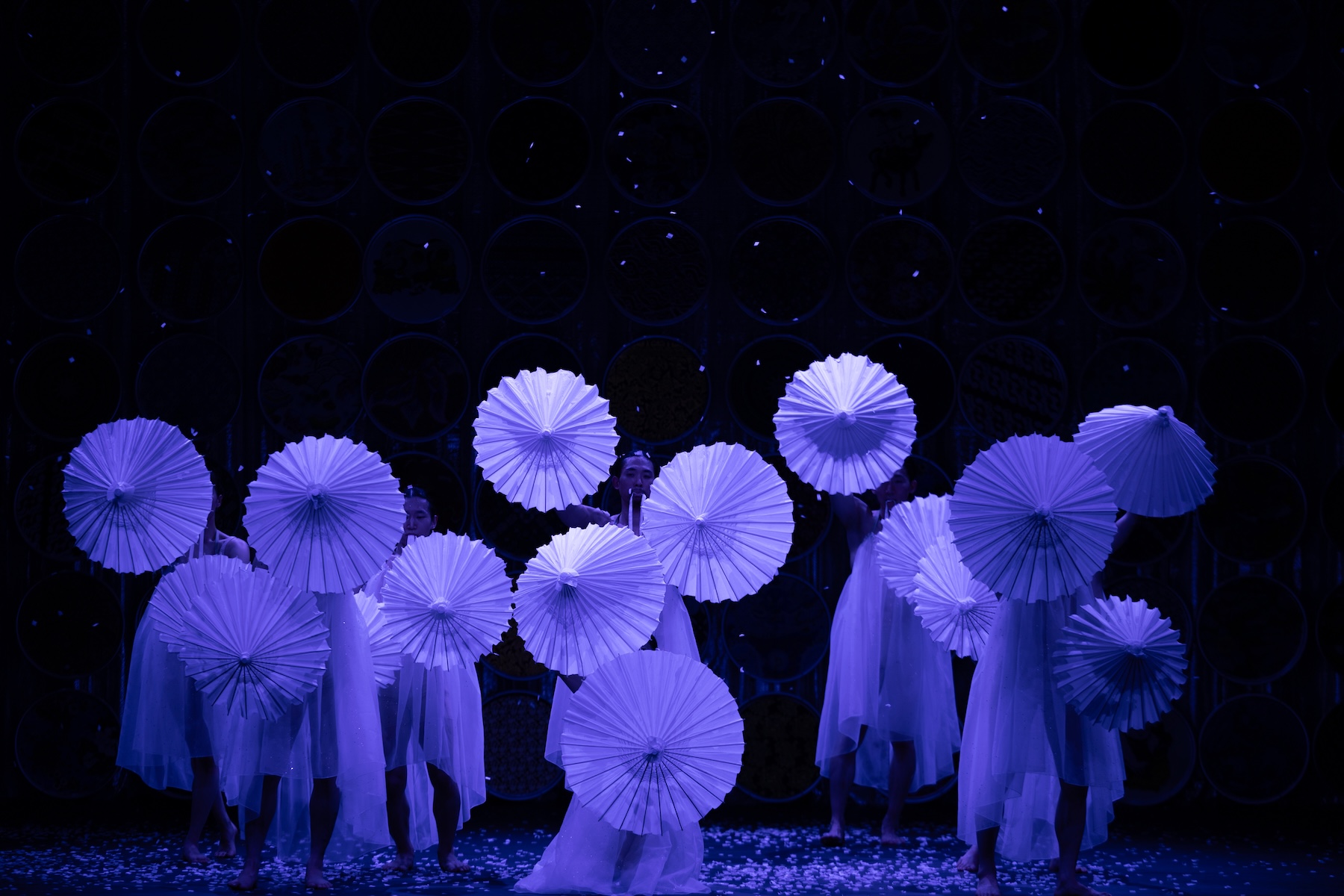
Finally, objects designed to protect against cosmic rays come into play. Hye-kyoung Kim, always in the front row, takes a seat on a white cloth and is pulled across the room in the lotus position. She holds a white paper umbrella in her mouth. Her face is horizontal, the handle of the umbrella perfectly vertical. An artistic way of simultaneously worshipping the sky and protecting oneself from it.

Sample of the white blossoms

Thomas Hahn

The white, light parasols stand at the center of the symmetrical, harmonious final image. “They are like white flowers and represent femininity and breast milk, while the stems symbolize the male part in the duality of yin and yang. This type of parasol originated in China and spread from there throughout Asia.”

Eun-me Ahn as Fury in black dragon dress

Sanghoon

Ahn also associates China with the black dress she appears in on stage at the end. It is covered from top to bottom with a golden dragon figure that seems to ensnare the wearer in its fire: “I modeled it after a design by the Chinese-American Hollywood star Anna May Wong.” Wong starred alongside Marlene Dietrich in Josef von Sternberg’s “Shanghai Express,” among other works. Now Eun-me Ahn wears the dress and dances in a spirit that is very different to that of cute femininity.
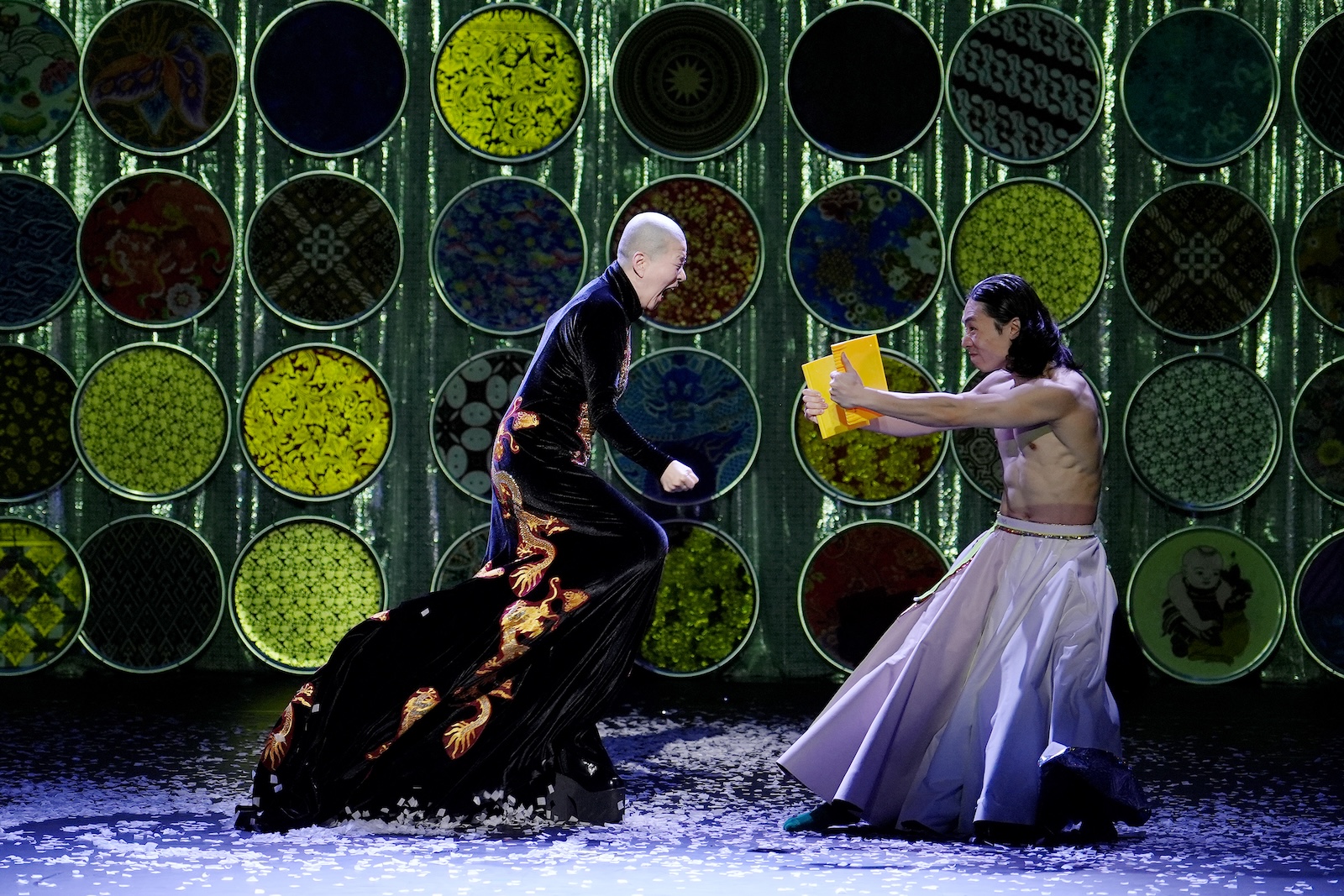
studio rehearsal

Thomas Hahn

“I looked at the ideas some people have about Asian dances and superimposed them with other movement patterns to create very strong new steps and movements. These are dances that come from the future,” she says. For Ahn, the future means the expansion of the respective traditions through global internet and pop culture. She wants a “positive future,” one that is not characterized by mutual prejudices, but by a shared culture of fun. Her “Post-Orientalist Express” conveys a mischievous message to the Occident, which could perhaps be formulated as follows: If you reduce us to traditional music and dance styles, we find it amusing. But in reality, we mix everything with everything else and confuse your senses with this parody.

The backdrop is the palette

Jean-Marie Chabot

This applies to the dances as well as the stage design—a kind of visual kaleidoscope of Ahn’s travels through the Orient. Like an oversized pearl curtain, hundreds of large plates hang in rows from the ceiling, covered with colorful printed fabrics from all the countries she has visited.

Colorful moon jars

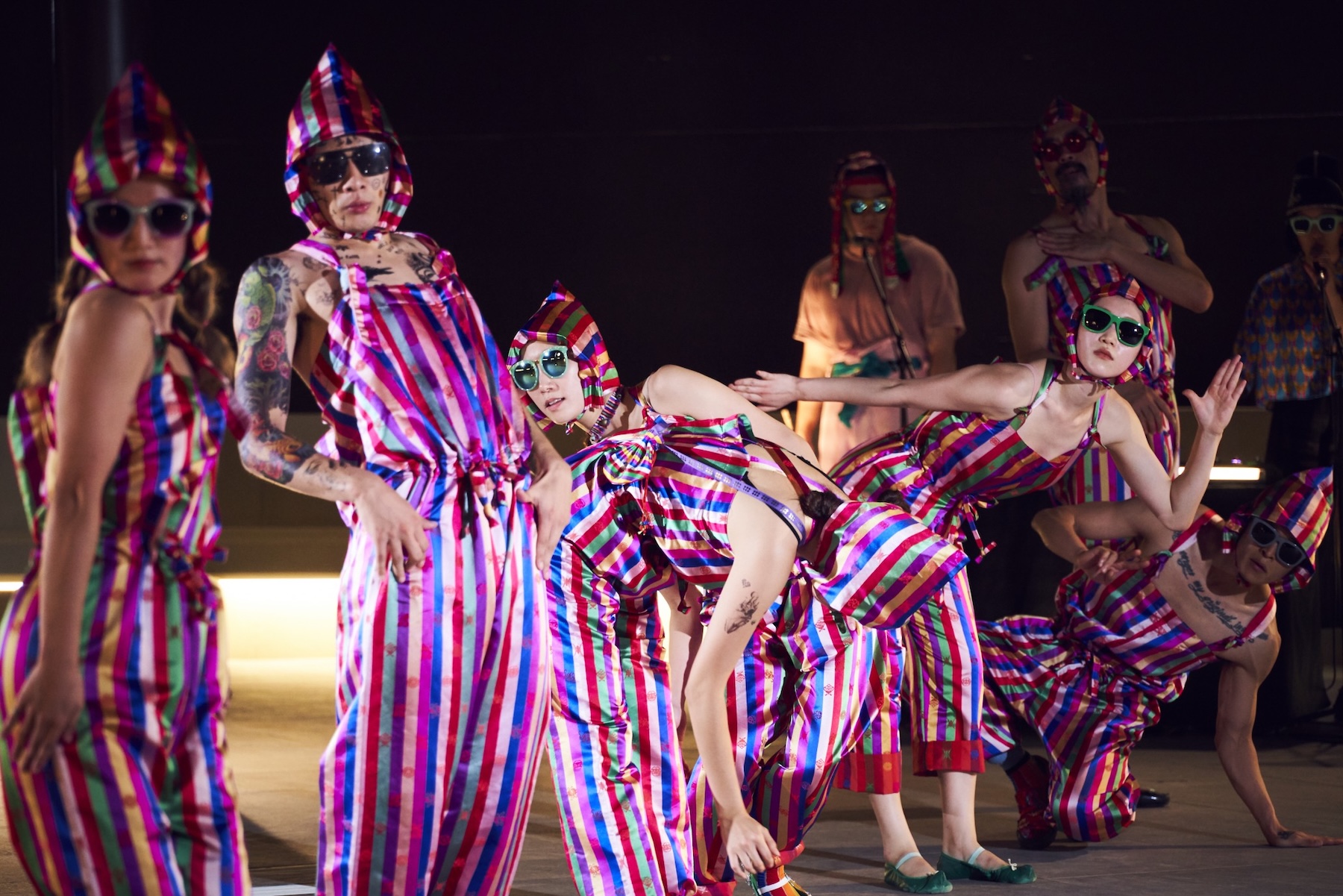
The skirts in which the nine dancers take their final bow allude to the Korean tradition of the moon jar. Since the 17th century, they have traditionally been made in shades of white and gray. In Ahn’s work, however, the moon jar skirts are vertically striped in all the colors of the traditional Korean Obangsaek color palette. What is missing is black, the symbol of water, the north, and winter. Strongly present are red (fire, south, summer), blue (wood, east, spring), white (metal, gold, west, autumn), and yellow (earth, center).

A similar moon jar with vertical stripes in the entire color palette of Ahn’s costumes also serves as the poster image for the “Couleurs de Corée” exhibition at the Centre Culturel Coréen in Paris. Ahn’s glowing skull in the moonlight seems to emerge from a colorfully striped moon jug.

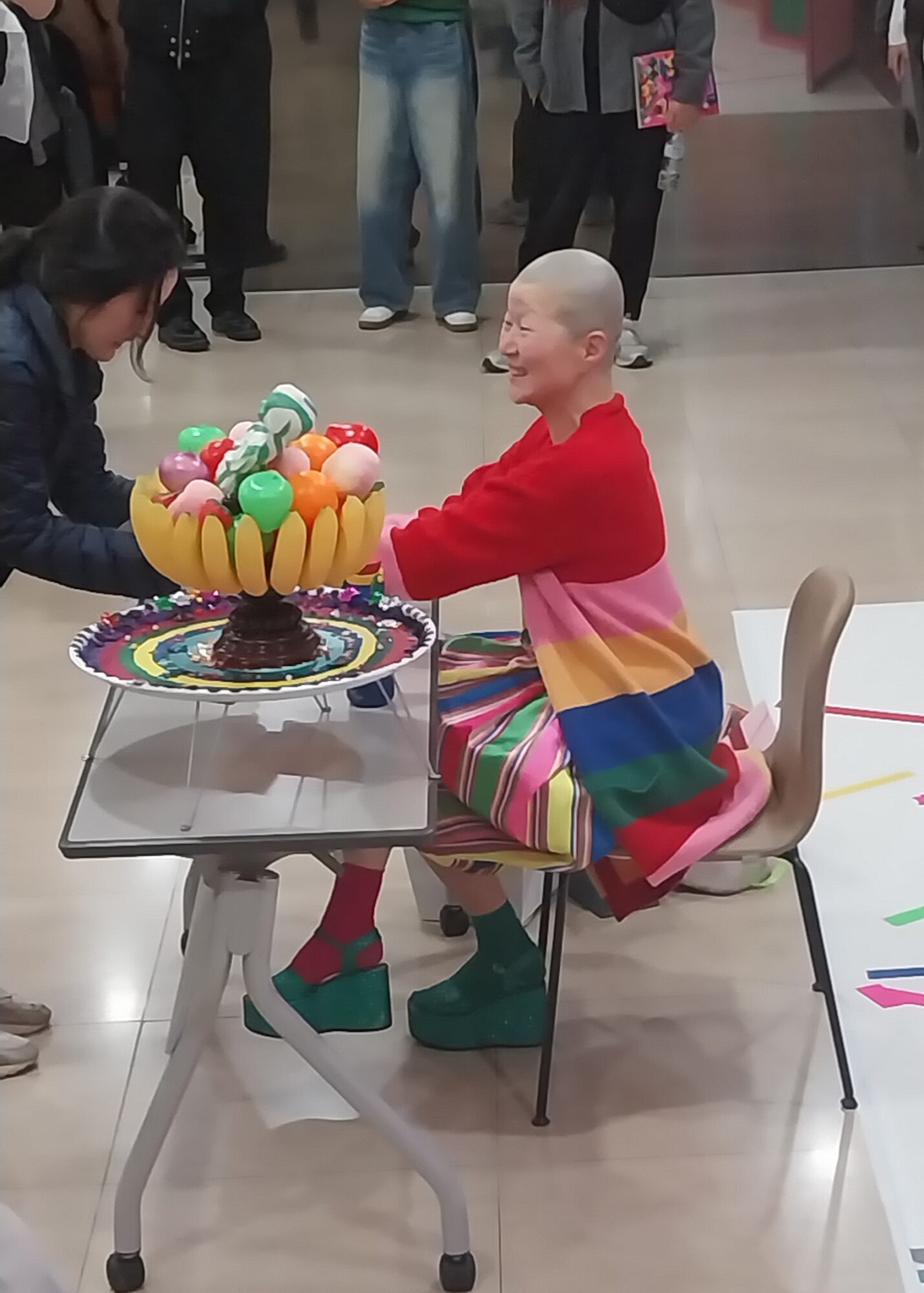
Eun-me Ahn in a striped dress: Autograph session after the premiere of “Post-Orientalist Express”

Thomas Hahn

Now, Eun-me Ahn’s broad, shiny skull and her flamboyant wardrobe are not just making waves in today’s South Korea. In Europe, too, she attracts everyone’s attention in her colorful striped dress. The enfant terrible does not propagate a gender punchline, but rather a more colorful vision of femininity. With this vision, she does not fit into any conventional Korean mainstream scheme, nor does she have any influence on the gross domestic product, unlike all the no less flamboyant K-pop and cinema productions.

Sung-bin Kim in full regalia presents the program book for “Post-Orientalist Express.”

Thomas Hahn

For the premiere of “Post-Orientalist Express” at the Sejong Center for the Performing Arts in Seoul, her staff are selling a colorful pop-style brochure. Ahn’s confidant, her assistant Sung-bin Kim, is dressed just as unconventionally as his boss. One might expect Ahn’s audience to dress in a similarly alternative style.

She has a small but loyal fan base, which makes it clear that this premiere is also a highly anticipated event.

On the one hand, there was more cheering than usual from Korea’s discreet audience during the final applause. In this respect, Ahn’s colorful, joyful hustle has a liberating effect. On the other, her fans were dressed so uniformly in dark colors that they looked like they were attending a company party. This may be because most of them take the subway home afterwards and don’t want to attract curious or judgmental glances. And Ahn? She will continue to defy the K-pop kitsch of her homeland, hide in her colorful bunker, and make herself scarce on the stages of Korea while touring extensively throughout Europe, North and South America, Asia, and Australia. There is a far greater chance of seeing her pieces elsewhere than in her homeland. But her studio will forever connect her to Seoul.

“Post-Orientalist Express”, 2025

Sukmu Yun, Jiyang Kim