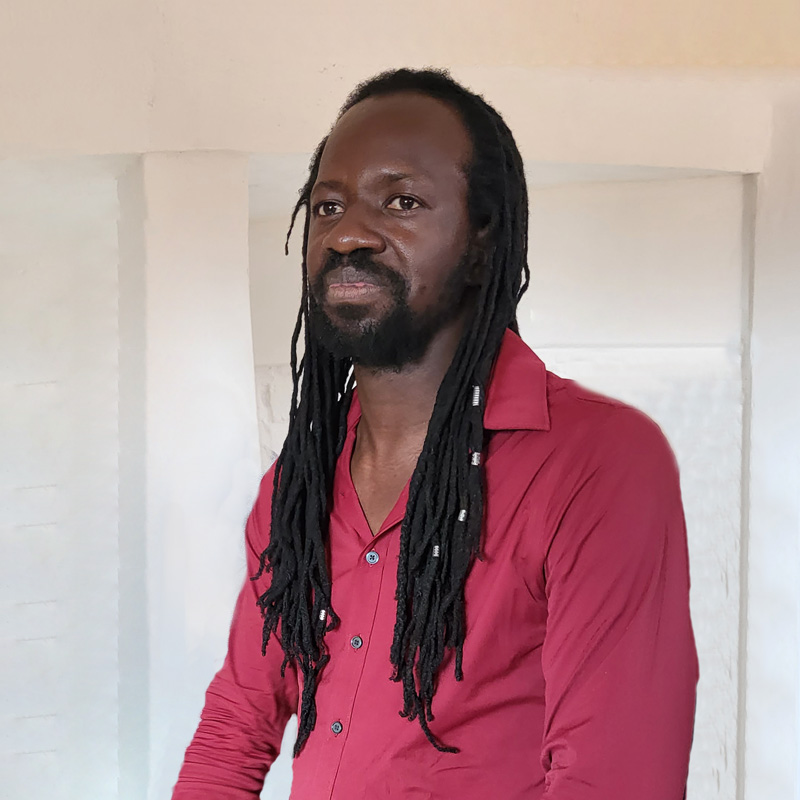
Serge-Aimé Coulibaly’s radiant smile outshines even that of Aguibou. He is the master who, in 2002, shortly after founding his own Faso Dance Company, appeared on Europe’s stages with the greats of that time – under Alain Platel (in “Wolf,” 2003) and soon after with Sidi Larbi Cherkaoui (in “Tempus Fugit,” 2004) – and received much acclaim when he worked with First Nations dancers from the Marrukegu Company in Australia (for example, in “Burning Daylight,” 2009). Undeniably, he is a king who never misses an opportunity to show what can actually be achieved in Bobo-Dioulasso: His own private rehearsal stage and theater have sprung up on the outskirts of town – a stage at its finest, innovative by European standards, both in terms of the recycled tire rubber dance floor and the biennial “Simply the Best” competition Coulibaly launched, in which the audience votes to select the best dancers in the country. He has also set up his own foundation, called Ankata, which provides microloans for the neighborhood, English language courses for the dancers, mental coaching, workshops, and, of course, dance training – everything Aguibou Bougobali-Sanou can only dream of. And now, to add the straw that breaks the African camel’s back, the king announces unapologetically that in February of all months, the month in which Aguibou’s festival has been happening for years, he and Aguibou’s former teacher Salia Sanou, “will jointly organize a large dance and music and theater festival in Bobo-Dioulasso.” Without Aguibou Bougobali-Sanou, of course.
With an appeasing gesture, the latter thanks his critics, who preferred to slap him in the face not behind the scenes but in the middle of his show and in front of an international audience. Africa is not for the faint of heart. He parries with an even more disarming smile. That’s how it’s done in Africa, where no one thinks much of solidarity but where everyone immediately shows each other how strong the competition really is. Later, Coulibaly explains that this was not malice but mere proof of how difficult it would be in Africa to bring dance professionals together: “This will only be possible with a great deal of trust, one-on-one talks, persuasion, and a certain authority. After all, it is primarily the ego of the artists that allows them to survive – an ego that is geared towards competition and tends to prevent collaboration.” This complicated field is not something he wants to abandon to this greenhorn. He says he is convinced that the collaboration with the famous dance couple Salia Sanou and Seydou Boro is also particularly important “to generate a greater audience and garner more attention. Do we really have to bring along anyone who can dance? No, we don’t. I simply had to defend myself, because I am also constantly being discussed. I don’t live in Bobo-Dioulasso as continuously as Aguibou. I come and go, I tour, I travel the world, which at least has the advantage that there is hardly any time to get into real trouble with the others here. Still, I have a passionate relationship with this city and I’m going to help shape the scene here in Bobo-Dioulasso.”